
What Is a Sinking Fund?
A sinking fund is money you set aside in advance for a specific future expense or need [S2]. Instead of waiting for the bill to arrive and then borrowing, you save in installments. With a sinking fund, you know the amount you want to have at the end and calculate how much to set aside over time [S1]. That is the defining feature: the target comes first, and the savings contributions follow.
Sinking funds can be used for planned car repairs, appliance replacement, insurance deductibles, holiday spending, a future tax bill, or business equipment purchases. A sinking fund may let you purchase the item with cash rather than take on debt [S1]. The common thread is preparation. You are building a pool of money that is earmarked for a purpose, rather than relying on a future loan or credit line.
In practice, a sinking fund works best when the expense is predictable enough to estimate and the deadline is clear enough to plan around. If the target amount or timing is uncertain, the fund may still be useful, but the contribution amount may need to be reviewed regularly. The exact account you use should depend on when you need the money and what access, risk, and tax rules apply to your situation.
What People Mean by an “Amortization Fund”
Amortization refers to the gradual repayment of a loan through regular installments that include both principal and interest payments, with the goal of fully paying off the debt by the end of the loan term [S2]. With an amortization, you usually obtain a loan at the beginning and pay off both the interest and the principal over time [S1]. Interest is the amount you pay the lender for extending the funds, while principal is the amount you originally borrowed [S1].
Because amortization is a repayment method, an “amortization fund” is usually shorthand rather than a distinct bank product. It may refer to a reserve set aside to make scheduled debt payments, or it may simply describe the cash flow created by a loan amortization schedule. The term is not used consistently, so it is worth asking a simple question: is the money going to a lender to reduce debt, or is it staying in an account until a future expense? If it is going to a lender, the process is amortization. If it is being accumulated in advance, it is closer to a sinking fund.
In a standard amortization, the borrower usually starts with a known loan amount, and the lender calculates the installment amount based on the loan terms [S1]. The details depend on the loan agreement, interest rate, term, fees, and repayment schedule. Those details can vary by lender and can change over time, so the current loan documents are the relevant source.
Sinking Fund vs Amortization Fund Explained: Side-by-Side
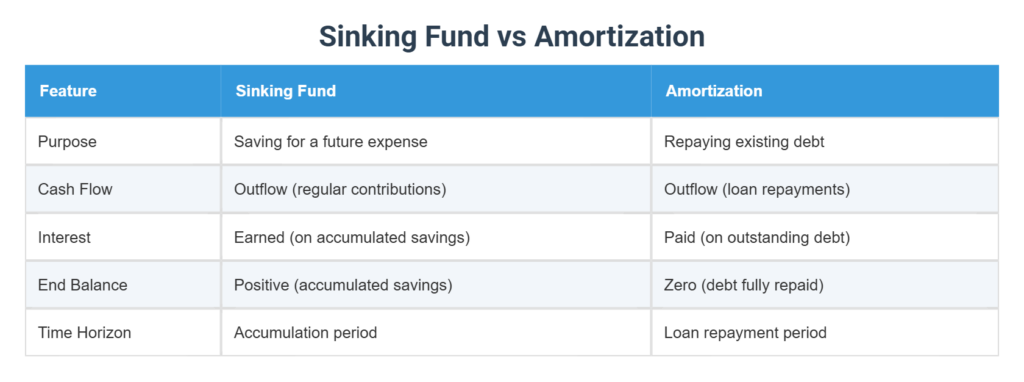
The table below summarizes the practical differences. It is a general comparison, not a substitute for reading the specific loan or account terms.
| Feature | Sinking fund | Amortization |
|---|---|---|
| Main purpose | Save for a specific expense or future need [S2] | Repay a debt over time [S2] |
| Cash-flow order | Save first, then spend or pay [S1] | Borrow or purchase first, then repay [S1] |
| What is known upfront | The desired ending balance; contributions are calculated to reach it [S1] | The amount borrowed; the lender calculates the installment [S1] |
| Interest | The saver may avoid borrowing and may earn interest depending on where the money is held | The borrower generally pays interest to the lender as part of the repayment [S1] |
| Typical examples | Planned repairs, replacement purchases, future bills, reserves for specific needs [S2] | Mortgages, auto loans, personal loans, business loans repaid in installments [S2] |
Why Cash-Flow Timing Changes the Decision
The most important difference is timing. In a way, amortization is the opposite of a sinking fund with regard to the timing of cash flows [S1]. With amortization, the loan or purchase happens near the beginning, and the payments follow over time [S1]. With a sinking fund, the saving happens first, and the purchase or payment follows later [S1].
That difference affects both discipline and cost. Amortization can be useful when you need the asset or funds now and are willing to pay interest for the ability to repay over time. A sinking fund can be useful when you can wait, want to reduce the need to borrow, and are prepared to make regular contributions before the expense arrives. Neither method is automatically better. The right choice depends on the size and timing of the expense, the loan terms available, the savings timeline, and how the cash flow fits your budget.
It also helps to separate the label from the behavior. A loan payment labeled as an “amortization fund” contribution is still a debt payment if the money goes to the lender. A savings transfer labeled as a “reserve” is still a sinking fund if the money stays in your account for a future need. The name matters less than where the money goes and what obligation it is meant to satisfy.
Practical Examples: When to Use Each
- Replacing a roof or major appliance later: A sinking fund fits when you can estimate the future cost and save monthly before the purchase.
- Taking out a car loan: Amortization fits the loan itself, because the repayment schedule includes principal and interest over the loan term [S2].
- Saving for an annual insurance premium: A sinking fund can smooth out a large planned bill by setting money aside in advance.
- Paying down a mortgage: The mortgage repayment is amortization when regular payments reduce principal and interest over time [S2].
- Preparing for a scheduled business obligation: A reserve may be treated like a sinking fund if cash is accumulated ahead of time; the loan itself is amortized if payments are made to a lender.
These examples are not recommendations for a particular person or business. They simply show the direction of cash flow. Ask whether the money is being accumulated before a need or sent to a lender after financing has already been received.
Common Mistakes and What to Watch
- Treating every savings account as a sinking fund: A sinking fund usually has a purpose, target, and rough timeline. Without those, it is just general savings.
- Assuming “amortization fund” is a standard product: Clarify whether the phrase means a loan repayment schedule, a reserve, or something else.
- Ignoring interest in the comparison: Amortization generally involves interest paid to a lender, while a sinking fund may involve interest earned or no interest at all depending on where the money is held [S1].
- Forgetting fees and account rules: Loan terms, interest rates, tax treatment, withdrawal limits, and provider policies can vary and may change. Confirm current documents before acting.
- Mixing the two goals: If the same pool of money is meant both to repay debt and to cover a future expense, separate tracking can make the cash flow clearer.
Quick Decision Checklist
- Is the money going to a lender to reduce an existing debt? If yes, you are likely dealing with amortization [S2].
- Is the money staying in an account until a future expense? If yes, you are likely dealing with a sinking fund [S2].
- Do you need the purchase or funds now? Amortization may fit if the loan terms are acceptable.
- Can you wait and save in advance? A sinking fund may reduce the need to borrow.
- Have you checked the current loan agreement, account rules, fees, and tax treatment? Those details can change and should be confirmed.
In short, the sinking fund vs amortization fund explained comparison comes down to direction and purpose. A sinking fund saves first and spends or pays later; amortization borrows or purchases first and repays later [S1]. Both can involve regular contributions toward a financial goal [S2], but they solve different problems. Use a sinking fund to prepare for a planned expense, and use amortization language when the real subject is loan repayment. When the labels are unclear, follow the cash flow.
Sources for Editorial Review
These are relevant pages found during drafting, not proof that any claim has been verified. Review factual statements and citations before publication.
- Editorial source lead [S1]: What Is the Difference Between Amortization & a Sinking Fund ? (sapling.com)
- Editorial source lead [S2]: Amortization vs . Sinking Fund – What’s the Difference? | This vs . That (thisvsthat.io)





