
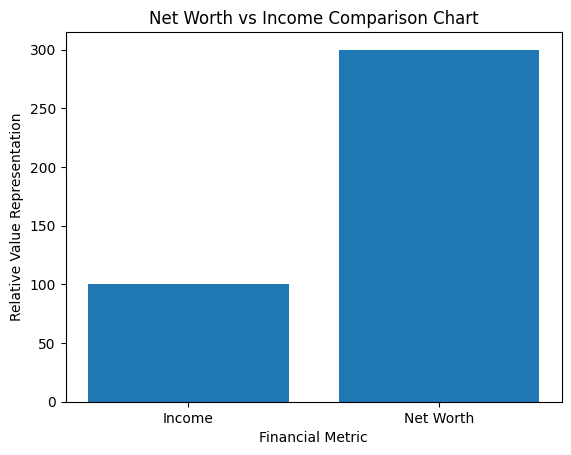
Why Net Worth and Income Get Confused
People often use “rich,” “wealthy,” and “high earner” as if they mean the same thing. They do not. Income measures money coming in over a period, while net worth measures what you actually own after debts are subtracted at a single point in time. A person can earn a large salary and still have a modest net worth, or earn a modest income and hold a substantial net worth. Understanding the difference changes how you judge financial progress.
The confusion is partly a language problem. Financial headlines about “the richest professions” typically rank income, while headlines about “the wealthiest people” typically rank net worth, and the two lists barely overlap once compared directly because they measure different things [S1]. Once you separate the two ideas, many seemingly contradictory financial situations make sense.
The Core Definitions: Stock vs. Flow
Net worth is a snapshot at a single point in time: total assets minus total liabilities. It is a stock variable, not a flow. It does not reset each month; it carries forward and compounds, or erodes, based on what happens to income, spending, debt, and investment returns over time [S1].
Income is a flow. It is the money received during a period, such as a salary, hourly wages, business profits, rental receipts, or interest and dividends. Because income arrives repeatedly, it feels like the main measure of financial success. But income only tells you what passed through your hands. Net worth tells you what stayed.
A simple way to keep the two straight:
- Income answers: “How much came in this month or year?”
- Net worth answers: “What is left if I sold everything and paid every debt today?”
- Cash flow connects them: income minus spending and debt payments determines whether net worth tends to rise or fall.
Worked Examples: Four People, Four Different Pictures
These examples are illustrative, not real people or verified cases. They are designed to show how income and net worth can diverge. Amounts are simplified for clarity.
Example 1: The High Earner With a Thin Balance Sheet
Consider a professional earning ₹60 lakh a year whose lifestyle consumes most of it [S1]. Suppose they hold ₹10 lakh in savings and investments, own a car worth ₹8 lakh with a ₹6 lakh loan, and rent their home. Assets total ₹18 lakh; liabilities total ₹6 lakh; net worth is ₹12 lakh. On paper the income looks impressive, but the financial position is fragile. A job loss would quickly force borrowing. The gap between earnings and net worth exists because spending grew alongside income.
Example 2: The Modest Earner With Real Assets
Now consider a retired small business owner earning ₹4 lakh a year in passive rental income [S1]. Suppose they own a home worth ₹80 lakh outright and hold ₹40 lakh in savings and investments, with no debt. Net worth is ₹1.2 crore. Their income is a fraction of the professional’s, yet their net worth is ten times larger. This is not a trick of arithmetic; it reflects decades of saving, debt repayment, and asset appreciation. It also shows why comparing incomes alone can mislead.
Example 3: The Same Income, Different Outcomes
Two coworkers each earn ₹12 lakh a year. One rents, saves 10%, and carries a car loan. The other bought a modest home years earlier, pays down the mortgage, and invests regularly. After five years, the first may have a net worth near zero while the second has built equity and investment balances. Income was identical; net worth diverged because of spending, debt, and investment returns over time [S1].
Example 4: The Business Owner’s Uneven Income
A shop owner might earn ₹30 lakh in a strong year and ₹5 lakh in a weak one. Annual income swings widely, but the business itself, inventory, equipment, and retained savings contribute to net worth that changes more gradually. Judging this person only by this year’s income would miss the durable value they have built.
A Practical Comparison Table
The table below summarizes how the two measures behave in common situations. It is a general illustration, not financial advice.
| Situation | Income Effect | Net Worth Effect |
|---|---|---|
| Salary increase | Rises immediately | Rises only if extra money is saved or used to reduce debt |
| Large purchase on credit | No direct change | Falls: new liability without matching asset value |
| Paying down a loan | No direct change | Rises: liabilities shrink |
| Investment gains | May not count as income until realized | Rises as asset values increase |
| Job loss | Falls to zero or near zero | Unchanged at first, then erodes as savings are spent |
| Home appreciation | No direct change | Rises if the home is owned and value increases |
How to Calculate Your Own Net Worth
Start by listing assets: cash, bank balances, investments, retirement accounts, property, and vehicles at realistic values. Then list liabilities: mortgages, personal loans, credit card balances, student loans, and any other debts. Subtract liabilities from assets. Repeat the exercise at regular intervals, such as quarterly or annually, so you can see the trend rather than a single snapshot.
Understanding your net worth can help you evaluate your financial health [S2]. A rising net worth over time usually signals that income is outpacing spending and debt. A flat or falling net worth despite good income is a warning sign worth investigating.
Keep these practical points in mind:
- Use consistent valuation methods so comparisons over time are meaningful.
- Include retirement accounts, even if you cannot access them yet.
- Do not count expected inheritances or future income.
- Track both the number and the direction of travel.
Why the Distinction Matters in Everyday Decisions
Income determines your capacity to save, invest, and repay debt. Net worth determines your resilience. A high income with low net worth leaves little buffer if earnings stop. A moderate income with a solid net worth can absorb shocks and provide options, such as retiring earlier, changing careers, or weathering a downturn.
The distinction also affects how you read financial news. Rankings of top earners and rankings of wealthiest individuals measure different things, and a person can appear on one list without appearing on the other [S1]. When someone says they are “doing well,” it is worth asking whether they mean cash flow, accumulated assets, or both.
Finally, remember that income can change quickly, while net worth tends to move slowly. That is why net worth is often the better long-term scorecard, even though income is easier to observe month to month. Neither number is meaningful in isolation; together they tell a fuller story.
Common Misconceptions
“A high salary means you are wealthy.” Not necessarily. If spending and debt rise with income, net worth may stay low [S1].
“Net worth is only for rich people.” Everyone has a net worth, even if it is negative. Calculating it is useful at any income level.
“Income is the same as cash flow.” Income is money received; cash flow also accounts for spending and debt payments. A person can have high income and negative cash flow.
“Assets always count at full price.” Values fluctuate. Property and investments should be valued realistically, and some assets are harder to sell than others.
Bringing It Together
Income and net worth answer different questions. Income shows what you earn; net worth shows what you keep. The examples above illustrate how two people with very different incomes can end up in very different financial positions, and how two people with the same income can diverge over time. Tracking both, and understanding how spending, debt, and investment returns connect them, gives a clearer picture than either number alone.
Details such as tax treatment, asset valuation, and account rules can change and vary by jurisdiction, so treat the figures here as illustrations rather than rules. For decisions with significant consequences, consult a qualified professional.
Sources for Editorial Review
These are relevant pages found during drafting, not proof that any claim has been verified. Review factual statements and citations before publication.
- Editorial source lead [S1]: Net Worth vs Income vs Wealth Explained | Capitallytics (capitallytics.com)
- Editorial source lead [S2]: How to Calculate Net Worth : Steps, Examples , and Tools (businessinsider.com)





