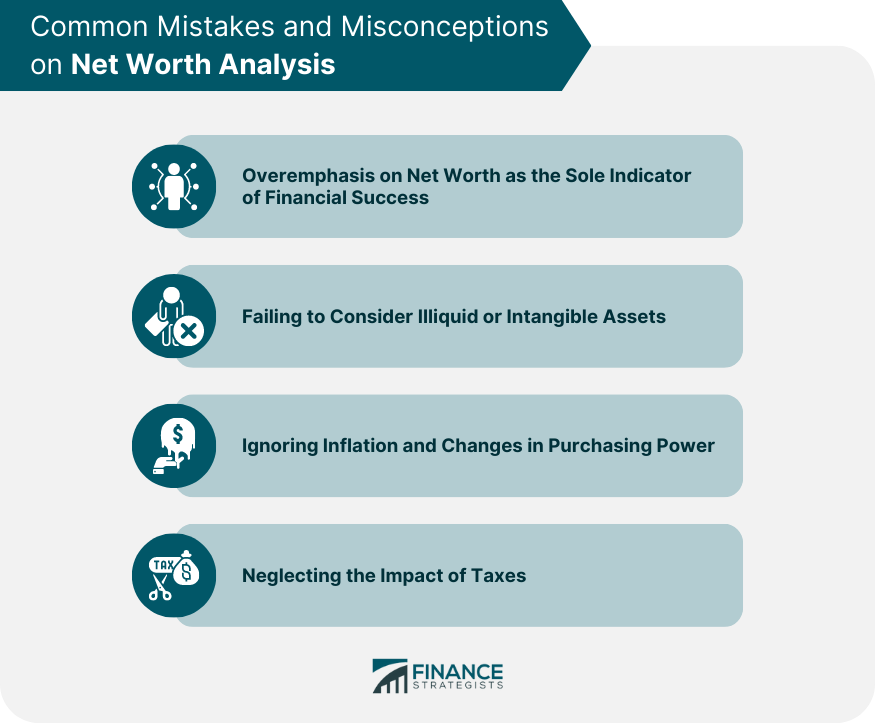
Why Net Worth Calculation Goes Wrong
Calculating net worth looks simple on paper: add up what you own, subtract what you owe, and the difference is your net worth. In practice, most errors don’t come from the arithmetic itself. They come from what gets left out on the liability side and from how assets are valued on the other side — a pattern that shows up again and again when people review their personal balance sheets [S2]. Getting the fundamentals right matters because a net worth figure is only useful if it reflects reality and can be compared meaningfully over time.
This article walks through seven common mistakes, explains why each one distorts the picture, and offers a practical fix. Treat it as a checklist the next time you sit down to update your numbers.
Mistake 1: Leaving Liabilities Off the Balance Sheet
The single most common source of calculation error is omission — usually a forgotten liability [S2]. Credit card balances, student loans, car financing, and mortgages are the obvious ones, but smaller obligations slip through: buy-now-pay-later plans, outstanding medical bills, owed taxes, personal loans from family, and pending legal or contractual obligations.
A liability missing from the list doesn’t just reduce accuracy; it inflates your net worth in a way that can lead to poor decisions, such as assuming you have more room to spend or borrow than you actually do. The fix is procedural: keep a running list of every debt with its current balance and update it on the same day you update your assets. If you use a budgeting app or spreadsheet, reconcile the debt list against statements rather than from memory.
Mistake 2: Valuing Assets Inconsistently or Unrealistically
Where liabilities are often forgotten, assets are often overstated. The second major error category is inconsistent or unrealistic valuation [S2]. Common examples include:
- Counting purchase price as current value for cars, electronics, or furniture that have depreciated.
- Using asking prices from listings rather than evidence of what comparable items actually sell for.
- Inflating sentimental or non-liquid items, such as heirlooms, art, or a second home, based on perceived rather than resale value [S1].
- Mixing valuation dates — for example, a home valued two years ago alongside today’s bank balances.
A useful discipline is to state the valuation method next to each asset: account balance, recent comparable sale, appraisal, or conservative estimate. For non-liquid items, research comparable sales or consult an appraiser rather than guessing [S1]. When in doubt, choose the more conservative figure — an understated net worth is far less dangerous than an overstated one.
Mistake 3: Skipping the Date and Losing Comparability
A net worth figure without a date attached loses most of its value, because the entire purpose of calculating it is to compare it against a future calculation and see the direction of change [S2]. Without dates, you can’t tell whether a jump came from saving, market movements, or simply a different valuation method.
The practical habit: write the date alongside the number every single time. Better still, record the date for each asset and liability line, especially for items whose values move independently of your actions, such as investments and property. When you compare two snapshots, you’ll then know whether you’re comparing like with like.
Mistake 4: Mishandling Pensions, Retirement Accounts, and Hard-to-Value Assets
Retirement savings are a major part of many households’ net worth, but they are easy to handle badly in two opposite ways: either counting them at a distorted value or ignoring them altogether.
Defined-contribution accounts with a visible balance are straightforward — use the current statement value. Defined-benefit pensions with no individual account balance are the hardest to value; they are often excluded from net worth entirely, or included only as a rough estimated present value if you have access to that calculation, which is a case where guidance from a financial professional is genuinely useful rather than optional [S2].
The key is consistency. Whatever you decide — include an estimate, exclude entirely, or list separately — apply the same rule every time you calculate. Changing methodology between snapshots creates fake gains or losses. If you exclude a pension, note that decision in your records so future comparisons remain honest.
Mistake 5: Double-Counting or Mixing Business and Personal Finances
Double counting is subtler than forgetting a debt, but it distorts results just as much. Typical traps include counting the full value of a home while also counting a separate savings fund earmarked for the down payment on that same home, or counting an investment account balance and also the individual holdings inside it.
Business owners face a related problem: personal net worth should not casually absorb business assets without accounting for business liabilities, nor should personal loans made to the business be counted as assets while the corresponding debt is ignored. The cleanest approach is to decide explicitly whether the business is inside or outside your personal net worth calculation and to document that choice. If it’s inside, list business assets and business debts together; if it’s outside, exclude both sides.
Mistake 6: Comparing Your Number to Other People’s
Net worth figures are context-dependent. A given number can carry very different implications depending on location, cost of living, debt levels, and obligations [S1]. Comparing your figure directly to a friend’s, a colleague’s, or a headline average tells you little about your own financial position and can push you toward unhelpful decisions.
The more meaningful comparison is longitudinal: your own net worth this year versus last year, calculated the same way. Avoid comparing your net worth to others, since context varies widely [S1]. If you do look at benchmarks, treat them as broad reference points rather than targets, and adjust for your circumstances.
Mistake 7: Expecting Precision From Rough Inputs — or Letting Perfectionism Stop You
Two mirror-image errors round out the list. The first is false precision: presenting a net worth figure to the dollar when several components are estimates. The second is paralysis: refusing to calculate at all because some values are uncertain.
If net worth calculations feel overwhelming, a sensible approach is to start with a basic balance sheet listing all assets and liabilities, then refine details gradually [S1]. Round estimates where appropriate, label them as estimates, and improve accuracy over time as statements and appraisals become available. A good-enough figure updated regularly beats a perfect figure that never gets calculated.
One more caution: details such as how particular account types are treated, tax implications of asset sales, and pension valuation methods can change and vary by jurisdiction. Nothing here is tax or investment advice, and rules that apply today may not apply later — confirm specifics with a qualified professional where it matters.
A Practical Pre-Check Before You Calculate
Run through this short table before finalizing your next net worth snapshot:
| Check | Question to ask | Fix if the answer is “no” or “unsure” |
|---|---|---|
| Completeness | Is every debt listed, including small or informal ones? | Reconcile against statements and add missing liabilities [S2] |
| Valuation | Is each asset valued at a defensible current figure? | Use account balances, comparables, or appraisals; be conservative [S1] |
| Dating | Does the figure carry a specific date? | Add the date; note dates on volatile line items [S2] |
| Pensions | Is your treatment of pensions consistent with last time? | Apply the same inclusion rule each snapshot [S2] |
| Double counting | Are any assets or debts counted twice? | Consolidate overlapping accounts and earmarked funds |
| Comparisons | Are you measuring against your own past figures, not others’? | Track your own trend over time [S1] |
The Bottom Line
Accurate net worth tracking is less about math and more about discipline: complete liability lists, consistent and conservative valuations, dated snapshots, and a documented rule for tricky items like pensions. Avoid the seven mistakes above, and your net worth figure becomes what it should be — a reliable, comparable measure of financial direction rather than a number that flatters or misleads.
Sources for Editorial Review
These are relevant pages found during drafting, not proof that any claim has been verified. Review factual statements and citations before publication.
- Editorial source lead [S1]: Adam 22 Full Net Worth : Common Mistakes and How to Avoid Them (jewerlytoolsblog.edgeone.app)
- Editorial source lead [S2]: How to Calculate Your Net Worth Correctly (Formula…) | Capitallytics (capitallytics.com)