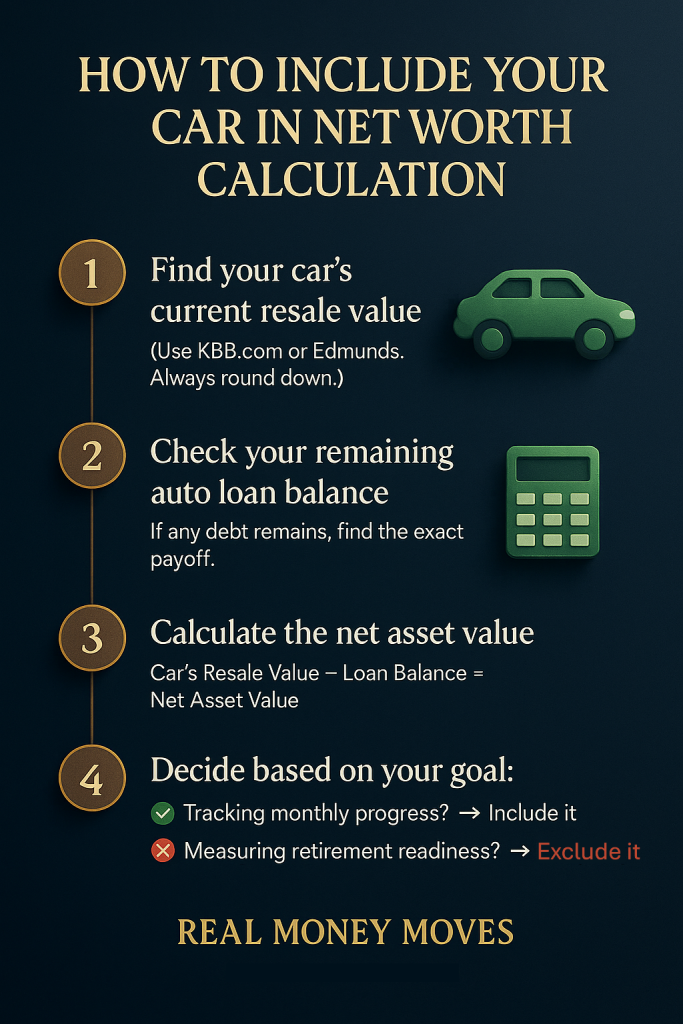
Why a Paid-Off Car Belongs in Your Net Worth
Net worth is a simple equation: what you own minus what you owe. A car you own outright is something you own, so its current market value counts as an asset in that calculation [S1]. The fact that it is paid off makes the accounting cleaner — you add the car’s value and subtract nothing for a loan, because there is no loan [S2].
That simplicity can be misleading, though. A paid-off car is a straightforwardly positive asset, but it is still a depreciating one [S1]. Its value will keep drifting downward even if you never drive it another mile. For net worth purposes, the goal is not to pretend the car holds its purchase price; it is to record what someone would realistically pay for it today, then update that figure periodically.
The most common mistake is valuing the car at what you originally paid. A vehicle bought for $42,000 three years ago is not a $42,000 asset now [S1]. Using the purchase price inflates your net worth and hides the real cost of ownership. The sections below walk through a practical process for getting a defensible number.
Step 1: Find the Right Market Value, Not the “Best Case” Value
Start with a current private-party or trade-in value from a recognized pricing source such as Kelley Blue Book or Edmunds [S1]. These two numbers can differ meaningfully, and choosing between them is a judgment call:
- Private-party value reflects what a buyer might pay you directly. It is usually the higher of the two and is a reasonable choice if you are willing to sell privately.
- Trade-in value reflects what a dealer might offer. It is lower and more conservative, and it may be the better choice if you would likely trade the car in rather than sell it yourself.
- Instant-offer or wholesale figures from online buyers tend to sit near the trade-in end of the range. They are useful as a sanity check.
Whichever figure you pick, apply it consistently. Switching methods from one update to the next makes your net worth trend line noisy and hard to interpret. Pick a convention — many people use private-party value for an owned car — and note it alongside your records so future updates are comparable.
Be honest about condition. A pricing tool’s default assumes an average example for the year and mileage. If your car has substantial cosmetic damage, a rebuilt title, or mechanical issues, adjust downward. If it is exceptionally clean and low-mileage, the tool’s condition tiers should already capture that. The point is to land on a number you would defend if someone asked, “Would you really get that for it?”
Step 2: Decide How Much Precision You Actually Need
Not every asset needs the same level of attention. Some people deliberately stop tracking an old, low-value paid-off car — say, one worth under roughly $3,000 to $5,000 — because the value is small relative to the effort of updating it regularly, and it does not move the overall picture much either way [S1]. That is a defensible simplification, as long as you make it consciously and apply it consistently.
A practical way to think about it:
| Approximate car value | Reasonable approach |
|---|---|
| Under ~$3,000–$5,000 | Optional to track; if tracked, one annual check is plenty, or use a flat placeholder figure |
| ~$5,000–$15,000 | Update once or twice a year using a pricing tool |
| Over ~$15,000 | Update at least twice a year; consider quarterly if you watch your net worth closely |
These thresholds are rules of thumb, not official standards — adjust them to your own net worth and how much the car’s value matters to the total. The broader principle is that precision should scale with materiality. Spending an hour revaluing a $2,500 car adds little information; spending twenty minutes twice a year on a $20,000 car is well worth it.
Step 3: Understand How Depreciation Interacts With the Number
Cars are unusual among common assets in that they reliably lose value every month you own them [S1]. That has two implications for your net worth tracking. First, a stale valuation overstates your assets — the longer it has been since you checked, the more error has accumulated. Second, the decline itself is informative: watching your car’s line in your net worth spreadsheet trend down is an honest reminder of the ongoing cost of ownership, separate from fuel, insurance, and maintenance.
Depreciation is not uniform across vehicles. Practical, functional vehicles — economy cars, compact SUVs, and reliable sedans from brands known for longevity — generally depreciate more slowly and carry lower operating costs over time [S2]. A paid-off car in that category may hold a meaningful value for many years, which strengthens the case for tracking it. A rapidly depreciating model may lose enough value in a year that a single annual update is sufficient; more frequent checks mostly confirm what you already expect.
There is one special case worth flagging: if you use the car for business purposes, it may be treated as a business asset, and its depreciation may be handled differently for tax purposes [S2]. Even in that situation, the car’s market value is still declining [S2]. Tax treatment and personal net worth tracking are separate exercises, so keep your personal balance sheet based on actual market value and handle the tax side with a qualified professional. Tax rules vary by jurisdiction and change over time, so verify current rules for your situation rather than relying on general summaries.
Step 4: Record It Consistently and Update on a Schedule
Once you have a current value, write it into your net worth record with three details: the valuation date, the source you used, and whether it was private-party or trade-in [S1]. Update the value periodically, since it keeps moving even when you do not [S1]. A simple calendar reminder twice a year is enough for most paid-off cars; quarterly works if the car is a large share of your assets.
A few practical habits keep the process clean:
- Revalue after major events. A collision, a major repair, or a big jump in mileage all affect value. Revisit the number then, not just on the calendar.
- Keep one method. Mixing trade-in and private-party figures across updates makes trends meaningless.
- Revisit the “don’t track it” decision. A car you stopped tracking at $3,000 is still worth something; if you are preparing for a loan application or a major financial decision, put a current figure back in for accuracy.
- Don’t double-count. If the car appears in your net worth, do not also list its value inside a separate “emergency fund” or “savings” bucket — it is one asset, counted once.
A Worked Example
Suppose you own a paid-off sedan outright. You look up its private-party value and see $9,400 for its year, mileage, and condition. You record “$9,400 — private-party — [date]” in your net worth sheet and set a reminder to check again in six months. At the next check, the same source shows $8,600. You update the figure. Nothing else changed: no loan exists, so the asset line simply moved down by $800. That $800 is real information about the cost of keeping the car, and it is exactly the kind of honest signal a net worth statement is supposed to provide.
Now suppose instead the car were worth $4,000 and you had decided to stop tracking it. You could either leave a placeholder figure in your records with a note that it is approximate, or omit it and acknowledge in your notes that your net worth slightly understates your assets. Either approach is fine as long as it is deliberate; what causes problems is a stale number that looks precise but is years out of date.
Common Mistakes to Avoid
- Using the purchase price. A car bought years ago is not worth its sticker price today [S1]. Always use current market value.
- Ignoring the loan in the other direction. For a paid-off car, there is no liability to subtract [S2] — but if you later finance a replacement, remember the loan must be subtracted from the asset’s value [S2].
- Valuing at replacement cost. What it would cost to buy a similar car is not the same as what yours would sell for. Use a selling-price estimate.
- Letting the number go stale. Values keep moving even when you do not [S1], so an unupdated figure quietly distorts your total.
- Over-tracking small assets. For a low-value car, the effort of frequent updates may exceed the benefit [S1]; a simpler approach is often better.
The Bottom Line
Valuing a paid-off car for net worth is not complicated: find a current private-party or trade-in value from a recognized source [S1], record it as an asset with no offsetting liability [S2], and refresh it periodically because the value keeps moving [S1]. Choose a level of precision that matches the car’s value to your overall finances, keep your method consistent, and be honest about condition. Do that, and your paid-off car becomes an accurate — if slowly shrinking — line on your balance sheet rather than a number that flatters it. Remember that specific thresholds, pricing tools, and tax treatment can change over time, so confirm current details before relying on them for major decisions.
Sources for Editorial Review
These are relevant pages found during drafting, not proof that any claim has been verified. Review factual statements and citations before publication.
- Editorial source lead [S1]: Should Your Car Count in Your Net Worth? Value, Loans, and … (steadywealth.app)
- Editorial source lead [S2]: Should You Include Your Car In Net Worth Calculations? (shunauto.com)