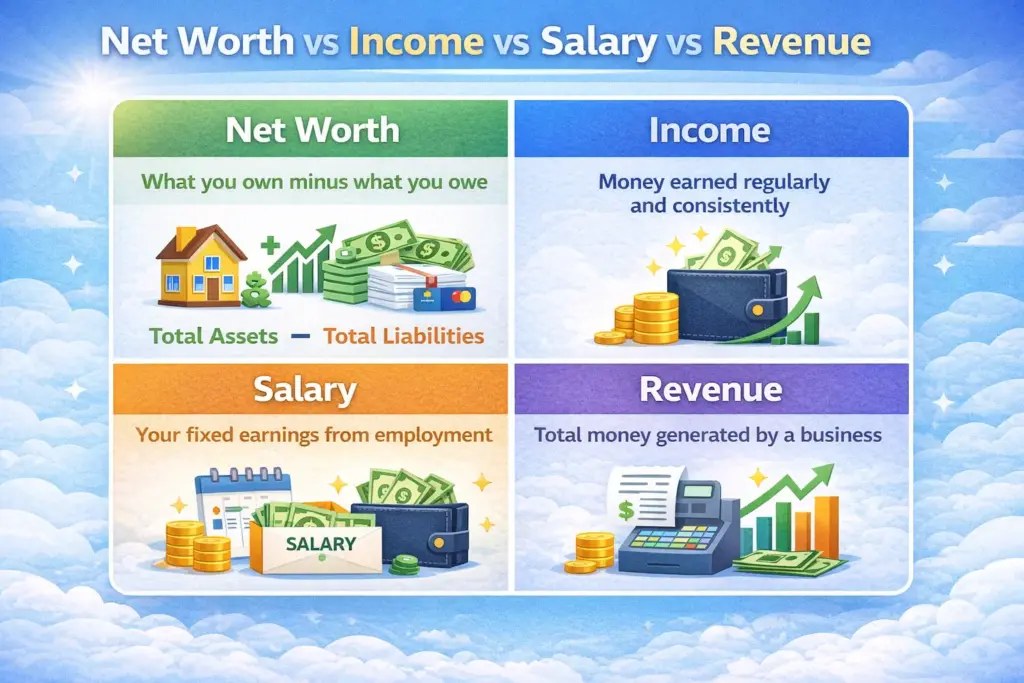
A salary increase feels like a financial milestone. It usually means more money arriving in your bank account each month, and it’s natural to assume that a higher income automatically translates into greater wealth. But net worth and income measure two very different things. Income is a flow — what comes in. Net worth is a stock — what you actually keep after debts are subtracted from assets. Understanding that distinction explains why a raise, on its own, may do surprisingly little for your long-term financial position.
This article looks at the common reasons a pay bump fails to move the net worth needle, from lifestyle inflation and tax withholding to debt and the psychology of spending. It also offers practical steps to make a raise count.
Why Earning More Does Not Automatically Build Wealth
The most fundamental reason a raise may not raise your net worth is that earning more and building wealth are separate concepts. Income describes how much money flows through your hands; net worth describes how much of it stays. Someone with a high salary who spends nearly everything they earn can have a modest or even negative net worth, while someone with a moderate salary who saves and invests consistently can build substantial assets over time.
This gap is sometimes described as the “high earner, low net worth” pattern: a person can earn a high salary and still struggle to build wealth [S2]. The distinction matters because a salary increase only affects the income side of the equation. Whether it improves your net worth depends entirely on what happens to that extra money afterward — whether it is saved, invested, or absorbed into spending.
Income and wealth are not synonymous, and treating a raise as automatic progress can mask the fact that your balance sheet hasn’t actually changed [S2]. A useful habit is to track net worth separately from salary: list assets such as savings, investments, and property, subtract liabilities such as loans and credit card balances, and review the result periodically. That number, not your paycheck, tells you whether you are getting wealthier.
How Lifestyle Inflation Absorbs a Raise
One of the most common reasons a raise disappears is lifestyle inflation — the tendency for spending to rise along with income. A higher salary often arrives alongside subtle pressures: a nicer apartment, a newer car, more frequent dinners out, upgraded subscriptions, or a more expensive commute. Individually these choices may seem reasonable; collectively they can consume the entire raise and sometimes more.
The result is that the extra income never reaches savings or investments. Some people describe this experience with phrases like “earned more, still broke,” and it reflects a common pattern rather than a personal failing [S1]. The raise changes the size of the paycheck but not the trajectory of the balance sheet.
Lifestyle inflation is easy to miss because it rarely happens in one dramatic decision. It accumulates through small, comfortable upgrades that feel justified by the extra income. The practical countermeasure is to decide in advance where the raise will go before it arrives. Redirecting a defined portion — for example, the majority of the after-tax increase — into savings or investments before it becomes part of your routine spending keeps lifestyle growth from quietly erasing your progress.
Why Raises Stop Feeling Like Progress
There is a psychological dimension to this problem as well. Psychologists use the term “hedonic treadmill” to describe how people tend to adapt to higher income and return to a similar baseline level of satisfaction, so that the raise that once felt transformative soon feels ordinary [S1]. Each increase sets a new reference point, and the satisfaction it brings fades as expectations adjust.
That adaptation matters for net worth because it drives spending. If a raise quickly becomes the new normal, spending tends to rise to match it, and the motivation to save the difference weakens. People may find themselves not happier even after their income rises substantially, and this holds even in cases where income doubles [S1]. The financial consequence is that the raise gets absorbed into a higher cost of living rather than converted into assets.
Recognizing the hedonic treadmill doesn’t mean raises are pointless. It means the benefit of a raise is not automatic — it has to be deliberately captured. If you notice yourself searching for explanations of why a salary increase didn’t make you feel better off, that’s a signal to pause and examine both your spending habits and your underlying financial goals [S1]. The extra money can still improve your security, but only if you direct it intentionally rather than letting it flow into upgraded consumption.
The Gap Between Gross Pay and Take-Home Pay
A raise is usually discussed in gross terms, but your net worth is affected by the money that actually reaches your accounts. Payroll taxes, income tax withholding, and benefit deductions mean that a $5,000 annual raise may add considerably less than $5,000 to your take-home pay. If withholding is miscalculated, the difference can be even larger when taxes are settled.
This is one reason the impact of a raise can feel smaller than expected. A common mistake is to commit to new recurring expenses based on the gross figure. When the actual increase in your bank balance turns out to be modest, the new spending can strain the budget rather than being comfortably covered.
It also affects saving strategy. If you plan to save “the whole raise,” the amount you can realistically redirect is the after-tax increase, not the headline number. Checking a recent payslip or using a payroll calculator to estimate the net effect of a raise before you plan around it helps set expectations accurately. Tax rules and withholding tables change over time and vary by jurisdiction, so it’s worth confirming current details with a qualified professional or your employer’s payroll department rather than assuming last year’s numbers apply.
How Debt and Fixed Obligations Consume a Raise
Even when a raise is saved rather than spent on upgrades, competing obligations can absorb it. High-interest debt is one of the most powerful drags on net worth: interest payments transfer money to lenders rather than building assets. If a raise arrives while you are carrying credit card balances or other expensive loans, redirecting the extra income toward those debts often produces a better net worth outcome than saving it at a low interest rate.
Other fixed obligations can also swallow a raise. Rising rent, childcare costs, insurance premiums, or loan repayments may increase around the same time as your salary. These are not necessarily discretionary choices, but they still reduce the amount available to improve your net worth.
The practical approach is to map your cash flow before and after the raise. Identify which obligations are fixed, which are variable, and which carry the highest interest rates. Then decide deliberately whether the extra income should pay down debt, build an emergency fund, or go into long-term investments. Each choice has a different effect on net worth, and the best answer depends on your circumstances.
Steps to Make a Raise Improve Your Net Worth
A raise can absolutely improve your net worth — but it needs a plan. The following table summarizes the main reasons a raise might not help and practical responses for each.
| Reason the raise doesn’t raise net worth | What’s happening | Practical response |
|---|---|---|
| Lifestyle inflation | Spending rises with income; the raise is absorbed | Decide the savings allocation before the raise arrives |
| Hedonic adaptation | New income becomes the new normal; satisfaction fades | Anchor goals to net worth, not to spending level |
| Taxes and withholding | Take-home increase is smaller than the gross figure | Plan around after-tax income; check a payslip |
| High-interest debt | Interest payments drain cash flow | Prioritize debt repayment with the extra income |
| Rising fixed costs | Rent, insurance, and other obligations increase | Map cash flow and protect a defined savings amount |
Several habits help convert a raise into real financial progress:
- Automate the increase. Set up an automatic transfer to savings or investments for the amount of the after-tax raise, ideally on payday, so the money never sits in your checking account waiting to be spent.
- Set a savings target in advance. Decide what percentage of the raise you will keep before the first higher paycheck arrives.
- Track net worth, not just income. Review assets minus liabilities regularly so you can see whether the raise is actually improving your position.
- Pay down expensive debt first. Compare interest rates on debts with expected returns on savings before deciding where the extra money goes.
- Plan for taxes. Use after-tax figures for budgeting and confirm current withholding rules rather than relying on outdated assumptions.
What to Do If a Raise Has Not Changed Your Net Worth
A salary increase is an opportunity, not a guarantee. Higher income can certainly contribute to a larger net worth, but it is not the sole determinant [S2]. The habits that surround the extra money — how much you save, how much you invest, how much debt you carry, and how deliberately you manage spending — play a much larger role in determining your financial future [S2].
If a raise hasn’t translated into a higher net worth, the cause is usually identifiable: lifestyle inflation, tax withholding, debt, or simple adaptation to a higher income. Each of these can be addressed with a clear plan. Treat the raise as a chance to change your savings rate rather than your spending rate, and the numbers on your balance sheet — not just your paycheck — will begin to reflect the difference.
Sources for Editorial Review
These are relevant pages found during drafting, not proof that any claim has been verified. Review factual statements and citations before publication.
- Editorial source lead [S1]: Why a Pay Raise Might Not Equal Greater Happiness: Understanding… (isfcm.com)
- Editorial source lead [S2]: Does a Higher Salary Ensure a Higher Net Worth? (thewealthminded.com)