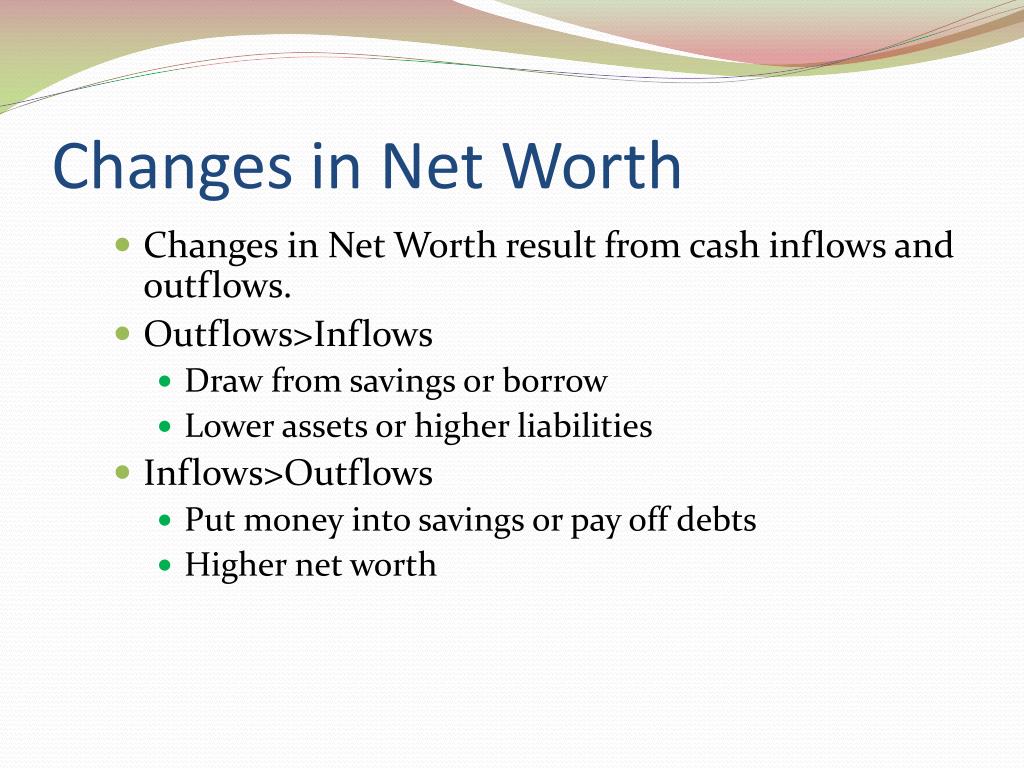
Why Your Net Worth Changes Without Spending Money
If you track your net worth, you have probably noticed something odd: the number can move even in months when you barely spend anything and your paycheck lands exactly as expected. You did not buy a new car or book a vacation, yet the figure on your spreadsheet went up or down. That is not a glitch. Net worth is a snapshot of what you own minus what you owe, and both sides of that equation shift on their own. This article explains the main reasons your net worth changes without spending money, why a monthly dip is usually not a verdict on your habits, and how to read the number in a way that is actually useful.
Net Worth Measures Both Sides of Your Balance Sheet
Net worth tracking answers a different question from expense tracking. Expense tracking asks, “Where did the money go?” Net worth tracking asks, “Am I getting richer?” Those are different questions with different implications: the first monitors cash flow, while the second measures financial progress [S1]. That distinction matters because expense tracking is liability-focused — it only monitors money leaving — while net worth tracking includes both sides of your financial picture [S1].
Once you frame net worth as a balance sheet rather than a spending record, it becomes obvious why the number can move without any spending involved. Anything that changes the value of an asset, the size of a debt, or the amount of cash you hold will change the total, regardless of whether you made a purchase.
Three Forces Move Your Net Worth Every Month
The confusing part of net worth is that it changes without you touching it. Three forces move it every month [S2]. In plain terms, those forces are:
- Market movements. Investments such as retirement accounts, brokerage holdings, and other market-linked assets rise and fall with prices. A fund can lose value in a month when markets drop, even if you held every share and did nothing.
- Debt and interest dynamics. Interest accrual, loan amortization, and other changes to what you owe affect net worth without any new spending. Conversely, paying down principal changes the composition of your balance sheet and, as explained below, the trajectory rather than the instant total.
- Cash flow and saving. Income you keep rather than consume adds to net worth, whether or not that money is spent on anything visible.
Because these forces operate continuously, a change in your net worth figure is not automatically a report card on your behavior. If you saved $800 in a month where the market fell 4%, your habits were good and your number went down anyway. The sensible approach is to read the trend over quarters and years, while reading your savings rate over months [S2].
Market Fluctuations: The Invisible Driver
For many people with retirement accounts or brokerage investments, market movement is the single largest source of net worth changes that have nothing to do with spending. Your account balance is revalued as prices change, and those changes flow straight into your net worth calculation. A bad month in the markets can wipe out the effect of careful saving, while a strong month can make you look like a disciplined saver even if your behavior barely changed.
This is why comparing your net worth at the start and end of a single month can be misleading. The number is doing two jobs at once: reflecting your decisions and reflecting conditions you do not control. Separating the two mentally is one of the most valuable habits in personal finance.
Debt Paydown: A Wash Today, a Gain Tomorrow
Debt paydown is a classic example of why net worth can appear to stand still even when you are making progress. A $500 principal payment does not change your net worth in that instant: cash falls $500 and debt falls $500, so it is a wash. What it changes is the trajectory. The $500 came out of income you did not consume, so it shows up as net worth you kept rather than spent, and every dollar of principal retired stops generating interest again [S2].
In other words, the benefit of debt paydown shows up over time through reduced interest costs and the difference between consuming and saving, not through an immediate jump in the total. If you only check your net worth now and then, you may miss the quiet improvement entirely. Note that the mechanics of specific loans vary — for example, how interest is calculated and how payments are applied — and those details can change, so verify them with your lender or loan documents rather than assuming a single formula.
Practical Ways to Read a Changing Number
Since net worth will move for reasons unrelated to spending, the goal is to interpret it well rather than react to every swing. Consider this practical framework:
- Track net worth regularly, but review it monthly at most. The point is to see the direction of travel, not to grade each week.
- Judge habits by your savings rate. Your saving behavior shows up in how much income you keep, which is something you control. Market results are outside your control.
- Evaluate the trend over quarters and years. As noted earlier, read the net worth trend over quarters and years while reading your savings rate over months [S2].
- Log the cause of notable changes. A short note such as “market decline” or “principal payment” turns a confusing number into a useful record.
- Keep tracking expenses when it serves a purpose. Expense tracking is still useful for finding leaks and steering cash flow; it simply is not the same tool as net worth tracking [S1].
| Situation | What Your Net Worth Shows | What It Does Not Necessarily Show |
| Market decline in a saving month | A lower number | Poor saving habits |
| Large principal payment | A roughly unchanged total | That the payment was pointless |
| Strong market month | A higher number | Disciplined behavior |
| No spending month | A changing number | That something went wrong |
Each row illustrates the same principle: the net worth figure mixes your actions with external forces, and the useful questions are about direction and cause, not any single reading.
When to Look Beyond the Total
Net worth is a valuable summary, but it is a summary. When the number moves surprisingly, ask two questions: did an asset revalue, or did a liability change? If the answer is neither, cash flow probably did the work. This simple diagnosis prevents the common mistake of changing your behavior in response to noise. The guidelines and conventions used by financial institutions, tax authorities, and financial data providers can change over time, so treat any specific rule of thumb as a starting point and confirm details with current, authoritative sources.
Net worth changes without spending money because it is a measure of your whole balance sheet, and balance sheets move on their own through markets, interest, and the simple act of keeping income rather than consuming it [S2]. Track it consistently, interpret it patiently, and let your savings rate carry the judgment about your habits. That combination turns a volatile number into a genuinely useful indicator of financial progress [S1].
Sources for Editorial Review
These are relevant pages found during drafting, not proof that any claim has been verified. Review factual statements and citations before publication.
- Editorial source lead [S1]: Stop Tracking Pennies: Why Net Worth Is the Only Metric That … (getfinny.app)
- Editorial source lead [S2]: What Your Net Worth Number Actually Means (and What It Doesn't) (spendify.money)