
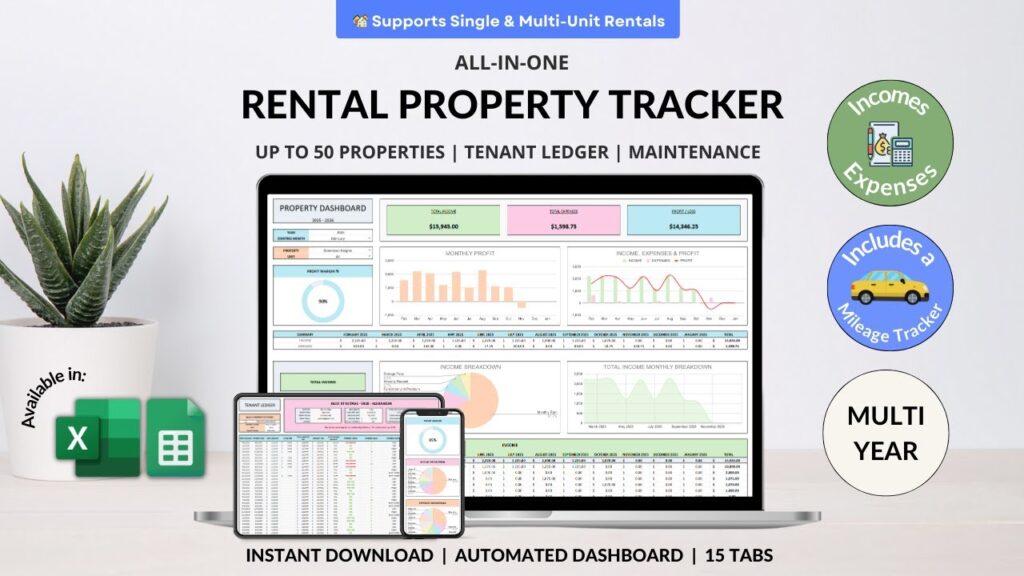
A rental property reserve account is dedicated savings for planned and unexpected rental property expenses. It acts as a buffer against unforeseen costs and planned capital expenditures, more like a property emergency fund and future investment pot than a routine operating account [S2]. Tracking that account is not just bookkeeping: a reserve fund tracker records money intentionally set aside for future property costs — such as large repairs, replacements, turnover shocks, insurance deductibles, or other planned contingencies — and shows how the reserve changes over time [S1].
The practical challenge is that a reserve account can look healthy on a bank statement while the property is actually underprepared for the next major cost. This article explains how to track a rental property’s reserve account with a simple ledger, consistent entries, and regular reconciliation. The goal is an internal record you can trust, separate from the confusion of a combined operating account.
Why the bank balance is not enough
If the same account holds rent receipts, tax money, routine operating cash, and savings for a future roof, the bank balance alone does not tell you what is truly available [S1]. That is the core problem a reserve tracker solves. A simple reserve ledger creates an internal boundary: this portion is intended for future property costs, and any withdrawal should have a documented reason [S1]. Tracking the reserve account therefore means tracking purpose, not only a balance.
This distinction matters when you are deciding whether a repair is affordable. A large bank balance might include tax money and operating cash that is not part of the reserve [S1]. A reserve ledger separates the portion set aside for future property costs from money that is merely passing through the account.
For landlords and property managers, the reserve record should answer three questions: How much is reserved? What is it reserved for? Why did a withdrawal happen? If the record cannot answer those questions, it is not yet a useful tracker.
Decide what the reserve account covers
Before you record transactions, define the purpose of the reserve. The categories can include large repairs, replacements, turnover shocks, insurance deductibles, or other planned contingencies [S1]. A reserve account can also cover planned and unexpected rental property expenses and act as a buffer against unforeseen costs and planned capital expenditures [S2]. Write these categories down and keep them with the ledger so every contribution and withdrawal is assigned consistently.
You do not need an overly complex chart of accounts. A short list of reserve categories is enough to make the ledger useful. For example, you might use broad categories such as capital repairs, unit turnover, insurance deductible, and general contingency. The exact labels are less important than using them consistently.
- Large repairs and replacements: future property costs that are too large to absorb as routine maintenance.
- Turnover shocks: costs that arise when a unit turns over and the reserve is needed to keep the property rent-ready.
- Insurance deductibles: the portion of a covered loss that the owner must pay.
- Planned contingencies: known future obligations or reasonable cushions for costs that are not part of the monthly operating budget.
Set up a simple reserve ledger
A practical tracker needs at least an opening reserve balance, contributions, withdrawals, withdrawal reasons, dates, and a running balance. The format can be a spreadsheet or accounting software, but the reserve ledger should be separate enough that it shows the portion intended for future property costs [S1]. If you use a property bank account, you can still maintain an internal reserve ledger; the point is to create the boundary between reserve money and routine operating cash [S1].
Start by recording the amount already set aside for the property’s reserve at the beginning of the tracking period. Then record each contribution and withdrawal in date order. After every entry, update the running reserve balance. That running total is what shows how the reserve changes over time [S1], and it is more useful than a list of transactions without a balance.
- Opening balance: the amount already reserved for future property costs at the start of the period.
- Contribution: money moved into the reserve from rent receipts or other property cash flow.
- Withdrawal: money taken out for a reserve-covered cost.
- Withdrawal reason: the documented purpose for the withdrawal [S1].
- Running balance: the reserve amount after each entry, so the ledger shows changes over time [S1].
Record contributions and withdrawals the same way every time
Consistency is more important than sophistication. Each time you add money to the reserve, record the date, amount, and source. Each time you withdraw, record the date, amount, reserve category, and a short note explaining why the money was needed. That note is the documented reason the ledger calls for [S1]. If a withdrawal does not have a reserve purpose, treat it as a warning sign that the money may have come from the wrong bucket rather than quietly reducing the reserve balance.
Keep the reserve record aligned with the actual bank account. A reserve tracker is not a second bank account by itself; it is a record of the portion intended for future costs [S1]. If the bank account holds both reserve and operating money, the ledger balance is the number you manage, while the bank balance is the number you reconcile against.
Use the same entry pattern for every transaction. That makes the ledger easier to review and prevents a common failure mode: a withdrawal is recorded as a lower balance, but the reason disappears. Without the reason, the reserve record stops explaining why the money was set aside in the first place.
Reconcile the reserve ledger with the account
At a regular interval you choose, compare the reserve ledger’s running balance with the bank account. If the account is dedicated only to reserves, the comparison is direct. If it also holds operating cash, reconcile the total transactions and verify that the reserve portion still reflects the intended internal boundary [S1]. The goal is to show how the reserve changes over time and to catch missing or misclassified entries before they distort the reserve balance [S1].
Reconciliation is not a one-time setup task. It is the routine that keeps the ledger honest. During reconciliation, look for contributions that were never recorded, withdrawals that lack a reason, duplicate entries, and withdrawals that were assigned to the wrong reserve category. Fixing those items at the account level prevents the reserve record from drifting away from reality.
Use a practical tracking table
A simple table keeps the ledger readable. The columns below are a starting point; adapt them to your property and accounting system. Leave the amount cells for your actual entries rather than estimating them in the template.
| Date | Description | Type | Reserve category | Amount | Running reserve balance | Documentation or reason |
|---|---|---|---|---|---|---|
| — | Opening reserve balance | Opening | — | — | — | — |
| — | Contribution to reserve | Contribution | General reserve | — | — | Transfer note or statement |
| — | Withdrawal for reserve cost | Withdrawal | Large repair, replacement, turnover, deductible, or planned contingency | — | — | Documented reason [S1] |
The table does not need to be elaborate. Its value comes from completeness: every contribution, every withdrawal, and every running balance should be present. If you prefer a list format, use the same fields as bullet items for each transaction. The important part is that the reserve record can be read without guessing which money belongs to future property costs.
Common tracking mistakes to avoid
- Relying on the bank balance: when the same account holds rent receipts, tax money, routine operating cash, and future reserves, the bank balance alone does not show what is truly available [S1].
- Leaving withdrawals undocumented: reserve withdrawals should have a documented reason so the ledger preserves the internal boundary [S1].
- Treating the reserve as routine operating cash: a reserve is dedicated savings for planned and unexpected rental property expenses [S2], and mixing it with routine operating cash blurs the internal boundary the ledger is meant to protect [S1].
- Forgetting to update the running balance: a tracker is meant to show how the reserve changes over time, so an unupdated ledger loses its main advantage [S1].
- Tracking categories inconsistently: if the same cost is sometimes labeled as a repair and sometimes as a contingency, the reserve report becomes harder to interpret.
Most of these mistakes come from the same root cause: the reserve account is treated as a single bank balance rather than a purpose-specific record. A simple ledger and a consistent entry routine solve that problem without requiring a complex accounting system.
Review the reserve against future costs
Tracking is not only about past transactions. Use the ledger to review whether the reserve is still positioned for future property costs such as large repairs, replacements, turnover shocks, insurance deductibles, or other planned contingencies [S1]. The reserve account acts as a buffer against unforeseen costs and planned capital expenditures [S2], so the tracking routine should make those future obligations visible rather than hiding them inside a combined bank balance.
A review can be simple: read the current reserve balance, compare it with the categories you defined, and note any category that is underfunded or overused. You do not need a formal forecast to benefit from this step. The point is to connect the ledger balance to the property’s future needs, not just to last month’s transactions.
Keep the reserve record simple and current
The best reserve tracker is the one you will actually update. A separate reserve ledger creates an internal boundary: a portion of the account is intended for future property costs, and any withdrawal should have a documented reason [S1]. That boundary is what makes the reserve account useful when a large repair, replacement, turnover shock, insurance deductible, or planned contingency appears.
Keep the ledger current, reconcile it with the account at a regular interval, and review it against future costs. You do not need to turn the reserve account into a second set of books. You need a clear record of what is reserved, what it is reserved for, and why money left the reserve. That is enough to track a rental property’s reserve account with confidence.
Sources for Editorial Review
These are relevant pages found during drafting, not proof that any claim has been verified. Review factual statements and citations before publication.
- Editorial source lead [S1]: Rental Property Reserve Fund Tracker (propertybinder.pro)
- Editorial source lead [S2]: Reserve Fund Account for Landlords & Property Management (baselane.com)





