
Tracking mortgage principal reduction on an investment property is one of those tasks that feels optional until tax season or a refinance forces you to reconstruct a year of payments. Unlike a primary residence, where mortgage interest is often a personal deduction with limited recordkeeping, a rental property ties every dollar of principal and interest to rental income, depreciation, and eventual capital gains. Getting the principal tracking right protects your cash-flow analysis and gives your accountant clean numbers to work with.
This guide covers how amortization works, where to find principal figures, how to build a practical tracking system, and how to handle extra payments.
Why Principal Tracking Matters More on an Investment Property
On any mortgage, each monthly payment splits into interest and principal. The principal is the amount originally borrowed, and only the principal portion actually reduces what you owe; in the early years of a loan, most of each payment goes toward interest and only a small fraction reduces the balance [S2].
For an investment property, that split carries different consequences than it does for a home. Interest is generally treated as a current operating expense for rental property reporting, while principal repayment is not deductible as an expense — instead, it increases your cost basis and reduces the loan balance that will eventually factor into gain or loss when you sell. If your bookkeeping lumps the full mortgage payment into a single “mortgage” expense line, you overstate deductions and understate basis, and you lose the ability to explain your position if you are ever questioned.
Accurate principal tracking also supports better decisions. Cash-on-cash return, debt service coverage, and the point at which a property becomes cash-flow positive all depend on distinguishing interest cost from equity buildup. A property that looks marginal on pure cash flow may be building substantial principal each year, and that only shows up if you track the split.
Where to Find the Principal Portion of Each Payment
You do not need to build the amortization math yourself unless you want to. Several reliable sources show the principal portion of every payment:
- Monthly statements: Most servicers show beginning balance, payment amount, principal applied, interest paid, and ending balance. This is the most authoritative record.
- Year-end statements (Form 1098): Reports total mortgage interest paid, which lets you back into principal if you know the total payments made.
- Online account history: Servicer portals typically list payment breakdowns by date and can often export to CSV.
- Your closing documents: The promissory note and amortization schedule establish the original loan terms and expected split.
- A spreadsheet amortization formula: Useful for projections and for checking servicer figures, but treat actual statements as the record of truth.
If you have multiple loans on one property — a first mortgage and a HELOC, for example — track each separately. Blending them makes it impossible to see which debt is actually amortizing.
Build a Simple Monthly Tracking System
A workable system needs one row per payment and a handful of columns. You can run it in a spreadsheet regardless of which software you use for bookkeeping.
| Column | What to Record |
|---|---|
| Payment date | The date the servicer applied the payment |
| Total payment | Full amount debited, including escrow if applicable |
| Interest portion | From the servicer statement |
| Principal portion | From the servicer statement |
| Extra principal | Any additional amount applied to principal only |
| Ending balance | Servicer-reported balance after the payment |
| Notes | Escrow changes, rate adjustments, fees |
Reconcile the ending balance to the servicer statement at least quarterly. If your calculated balance drifts from the servicer’s, you have either missed a payment, misclassified a fee, or failed to capture an escrow disbursement. Catching this monthly is far easier than reconstructing it in April.
If you use accounting software, map the mortgage payment to a liability account rather than an expense account. The interest portion posts to an interest expense account; the principal portion reduces the loan liability. This keeps your balance sheet accurate and produces a clean audit trail.
How Extra Payments Change the Principal Curve
Extra principal payments are the fastest way to change the shape of the amortization curve. Setting up recurring principal-only payments lets you chip away at the balance over time, and even modest monthly contributions can add up significantly over a year [S2]. One additional principal payment per year can meaningfully shorten the loan term and reduce total interest paid [S2].
On an investment property, decide in advance how you will treat extra payments in your records:
- Record extra principal as a separate line so it is never confused with deductible interest.
- Note whether the extra payment reduced the term or the required monthly amount, if your servicer offers that choice.
- Update your amortization projection after any lump sum so future interest estimates stay realistic.
- Keep documentation of lump-sum payments; they matter when you calculate basis and when you eventually sell.
Be aware that some servicers apply extra funds to escrow or to future scheduled payments unless you direct them to principal. Confirm in writing how the payment was applied, and check the next statement to verify it.
Common Mistakes and Year-End Cleanup
The most frequent error is treating the entire mortgage payment as an expense. A close second is relying on the Form 1098 interest total without verifying it against the sum of monthly statements, particularly if the loan was sold to a new servicer mid-year or if you made payments from multiple accounts.
Other pitfalls worth watching:
- Ignoring escrow: Property tax and insurance held in escrow are not principal and are not part of the loan balance reduction. Keep them in separate accounts.
- Missing rate changes: Adjustable-rate loans change the interest/principal split at each reset; re-baseline your projection when the rate changes.
- Skipping reconciliations: A small error in month one compounds into a large discrepancy by December.
- Conflating properties: Keep a separate loan ledger for each property so basis calculations stay clean at sale.
At year end, produce a one-page summary per loan: beginning balance, total payments, total interest, total principal, ending balance, and extra principal applied. Give this to your tax preparer alongside your income and expense records. It takes an hour to assemble and prevents weeks of reconstruction later.
A Note on Principal Reduction Programs
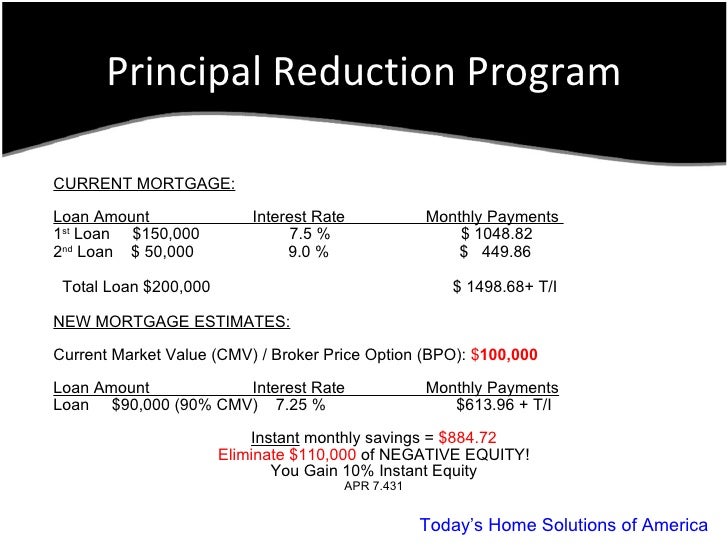
Separate from routine amortization, “principal reduction” can also refer to lender forgiveness programs. Those are difficult to obtain and are not a normal part of investment property financing. The major federal programs that once offered this kind of relief have ended, and loans owned or guaranteed by Fannie Mae or Freddie Mac currently prohibit it [S1]. If you are researching forgiveness rather than routine paydown, verify current program rules directly with your servicer and a HUD-approved housing counselor, since eligibility and tax treatment can change [S1].
For most investment property owners, though, “tracking principal reduction” simply means knowing, month by month, how much of each payment is building equity rather than paying interest. A modest spreadsheet, a quarterly reconciliation, and a clean year-end summary are enough to keep that number accurate.
Sources for Editorial Review
These are relevant pages found during drafting, not proof that any claim has been verified. Review factual statements and citations before publication.
- Editorial source lead [S1]: Mortgage Principal Reduction: Eligibility, Process, and Tax … (fedlaws.org)
- Editorial source lead [S2]: How to Pay Down Principal on a Mortgage | Chase (chase.com)





