Why a partnership interest belongs in net worth — but not at face value
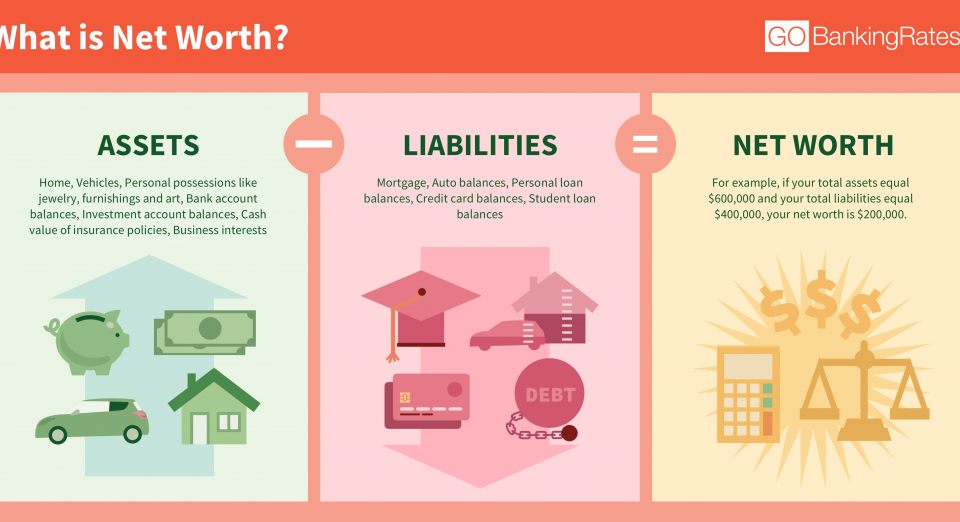
Personal net worth is usually described as assets minus liabilities, but the hard part is rarely the arithmetic. It is deciding what a given asset is actually worth on the day you measure it. A publicly traded stock has a quoted price; a car has a resale range; a savings account has a balance. A partnership interest has none of these. It is a legal claim on a business that may not be sellable, may not distribute cash on any predictable schedule, and may carry obligations the partner cannot easily escape.
That does not mean a partnership interest should be left out. If you own a meaningful stake in a partnership, omitting it would understate your net worth, sometimes dramatically. The practical solution is to include it as a single line item, valued with a documented method, and clearly labeled as an estimate rather than a market price [S1]. The rest of this article walks through how to arrive at that number, which method to use, and where partnerships create traps that a simple balance sheet hides.
Start by pinning down what kind of interest you actually hold
Partnership interests are not all the same, and mixing them up is the most common source of inflated net worth figures. At a minimum, you need to separate your capital interest from your profit interest, and you need to know whether your stake is a general partnership interest or a limited one.
A capital interest generally reflects your claim on the partnership’s capital — what you would receive if the partnership sold its assets and distributed the proceeds according to the agreement. A profit interest reflects your share of ongoing profits or loss allocations [S2]. These can diverge significantly: your contribution to the partnership does not necessarily dictate your share of profits, because profit splits can be shaped by the partnership agreement and negotiated terms [S2].
For personal net worth purposes, capital interest is usually the more relevant figure, because it approximates what you could eventually extract. A profit interest, particularly an unvested one, is speculative and often better disclosed as a note than counted as an asset. Similarly, a general partnership interest may come with unlimited liability or capital call obligations, which belong on the liability side of the ledger rather than being ignored.
A practical checklist before you value anything:
- Read the partnership agreement’s distribution and liquidation provisions, not just the ownership percentage.
- Confirm whether your interest is vested, and what happens to it if you exit or die.
- Identify any capital call obligations or guaranteed payments you are entitled to receive.
- Note transfer restrictions, rights of first refusal, and buy-sell formulas.
- Check whether the partnership has debt that is recourse to the partners personally.
The three common valuation approaches, and when each fits
There is no single correct method for valuing a partnership interest for personal net worth. Three approaches are commonly used, and the right choice depends on the nature of the partnership’s business and the quality of the information you can obtain [S1].
| Approach | How it works | Best suited to | Main weakness |
|---|---|---|---|
| Asset-based | Value the partnership’s underlying assets, subtract liabilities, apply your ownership share | Asset-heavy partnerships such as real estate or holding entities | Ignores earning power; asset values may themselves be estimates |
| Income multiple | Apply a market multiple to a normalized earnings figure, then apply your share | Operating businesses with stable, documented cash flow | Multiples vary widely and are easy to cherry-pick |
| Comparable sales | Reference prices paid for similar partnership stakes or similar businesses | Partnerships in industries with active transaction data | Comparable data for minority partnership stakes is often thin |
The asset-based approach tends to be the most defensible for a partnership that mainly holds investments or property, because the value does not depend on forecasting. The income approach is more appropriate where the partnership’s value derives from ongoing operations, but it requires reliable financial statements and a multiple you can justify. Comparable sales can be useful as a sanity check even when it is not the primary method.
Whatever method you choose, document it. A one-line note in your net worth spreadsheet explaining the approach, the date of the underlying financials, and any discounts applied will save you confusion the next time you update the figure.
Apply discounts — and be honest about why
A proportional share of a partnership’s value is rarely what a buyer would pay for your interest. Buyers discount for risks that a simple percentage calculation ignores: illiquidity, lack of control, dependence on key people, transition difficulty, unknown liabilities, and market conditions [S1]. The gap can be substantial. A business that feels like it is worth $200,000 to its owner might realistically sell for $120,000 when it meets the market [S1].
Some owners handle this by calculating a value and then tracking only a portion of the result — for example, 50 to 70 percent — to leave room for illiquidity and key-person risk [S1]. That is a blunt instrument, but it is transparent and conservative, which is usually the right bias for personal net worth tracking. Conservative estimates serve you better than optimistic ones, because the purpose of the figure is to inform decisions, not to flatter you [S1].
Two cautions. First, do not apply a discount and then also omit liabilities that the discount was meant to reflect; the result is a double count in the wrong direction. Second, be consistent year over year. If you change your discount methodology, note the change and restate the prior figure so your trend line means something.
Where partnerships complicate the liability side
Most net worth guides treat liabilities as mortgages, credit cards, and student loans. Partnerships introduce liabilities that are easy to overlook:
- Recourse debt. If the partnership borrows on a recourse basis, your share of that debt may be your personal obligation even though it appears only on the partnership’s balance sheet.
- Capital call commitments. An unfunded commitment to contribute capital is a real economic obligation, particularly in real estate and private investment partnerships.
- Guarantees. Personal guarantees of partnership debt belong in your personal liabilities.
- Tax liabilities on phantom income. Partnerships can allocate taxable income without distributing cash, creating a tax bill you must fund from other assets.
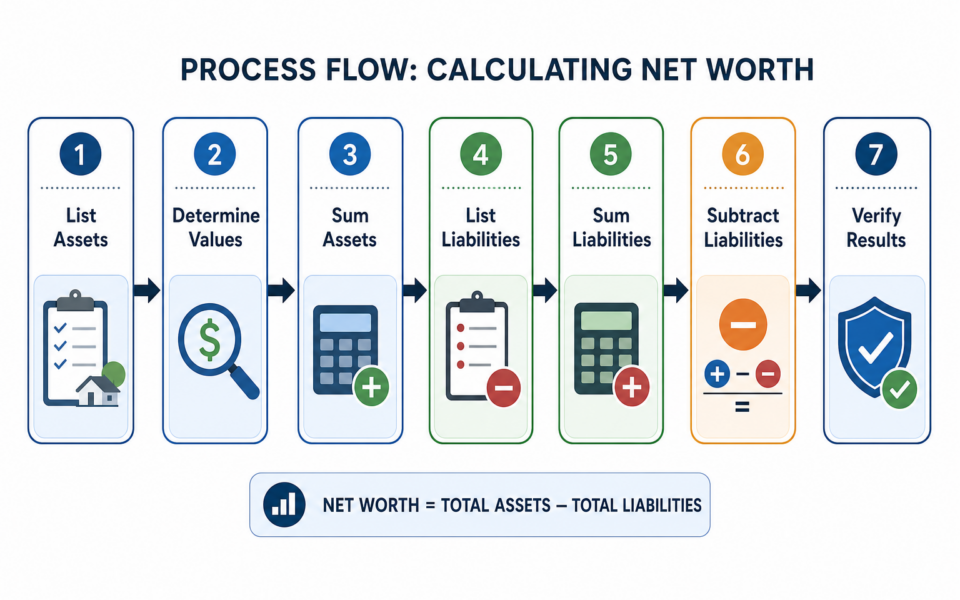
A clean approach is to record your net partnership interest as a single asset line, then list any personal guarantees, capital commitments, and estimated tax liabilities separately. That keeps the presentation simple without hiding obligations.
A repeatable process you can run each year
Valuing a partnership interest once is a project; valuing it annually is a habit. A workable sequence looks like this:
- Obtain the most recent partnership financial statements and the prior year’s Schedule K-1 for context.
- Select the valuation approach that fits the partnership’s asset base, and state it in writing.
- Compute your proportionate share using the ownership percentage stated in the agreement — not the percentage you assume.
- Apply a documented discount for illiquidity and other risks, or track a stated fraction of the computed value [S1].
- Record the result as one asset line, with the valuation date and method in a note.
- List guarantees, capital commitments, and phantom-income tax exposure as separate liabilities or notes.
- Update at least annually, and whenever a material event occurs — a sale, a new partner, a large distribution, or a death.
Keep the supporting documents with the figure. If you ever need to explain your net worth to a lender, a court, or an estate planner, the methodology matters as much as the number.
Finally, recognize the limits of this exercise. Personal net worth is a planning tool, not an appraisal, and partnership valuations for net worth purposes are estimates [S1]. Tax rules, partnership agreement terms, and accepted valuation practices change over time and vary by jurisdiction, so confirm the specifics with a qualified accountant or valuation professional before relying on the figure for lending, estate planning, or divorce proceedings. Treat the number as a well-documented estimate that you revisit regularly — which is exactly what it is.
Sources for Editorial Review
These are relevant pages found during drafting, not proof that any claim has been verified. Review factual statements and citations before publication.
- Editorial source lead [S1]: How to Include Business Assets in Personal Net Worth (financialaha.com)
- Editorial source lead [S2]: Interest in a Partnership Video – ExamPrep.ai CPA Review (cpa.examprep.ai)