Why a 401(k) loan complicates your net worth
A 401(k) loan looks simple on the surface: you borrow money from your own retirement account and pay yourself back with interest. But when you sit down to calculate net worth, that arrangement creates a genuine accounting question. The money is still yours in one sense, yet you also owe it back to the plan. Get the treatment wrong and your net worth can be off by the entire loan balance.
The core principle is straightforward: count the full plan balance as an asset, and count the outstanding loan as a liability. The trouble is that many people do the opposite of what they intend — either double-counting the loan or ignoring it altogether. This article walks through the correct approach, the common mistakes, and the practical decisions you need to make about taxes, vesting, and how much detail your net worth statement really needs.
The correct treatment: asset at full balance, liability at loan balance
When you take a 401(k) loan, your plan doesn’t remove the money from your account in an accounting sense. Instead, the plan sells investments and issues you cash, and the plan’s records then show the remaining invested balance plus a loan receivable — the amount you owe back to the plan. The total of those two figures equals what the plan holds on your behalf. That total is what belongs on the asset side of your net worth statement [S1].
Here’s a concrete illustration. Suppose your statement shows $55,000 invested plus a $9,000 loan receivable, for a total of $64,000. You should count the account at $64,000, because that is what the plan holds for you, and count the $9,000 you owe as a liability [S1]. The net effect on your net worth is the same as if the loan had never happened — which makes sense, because borrowing from yourself doesn’t create or destroy wealth. It just reshuffles where the money sits.
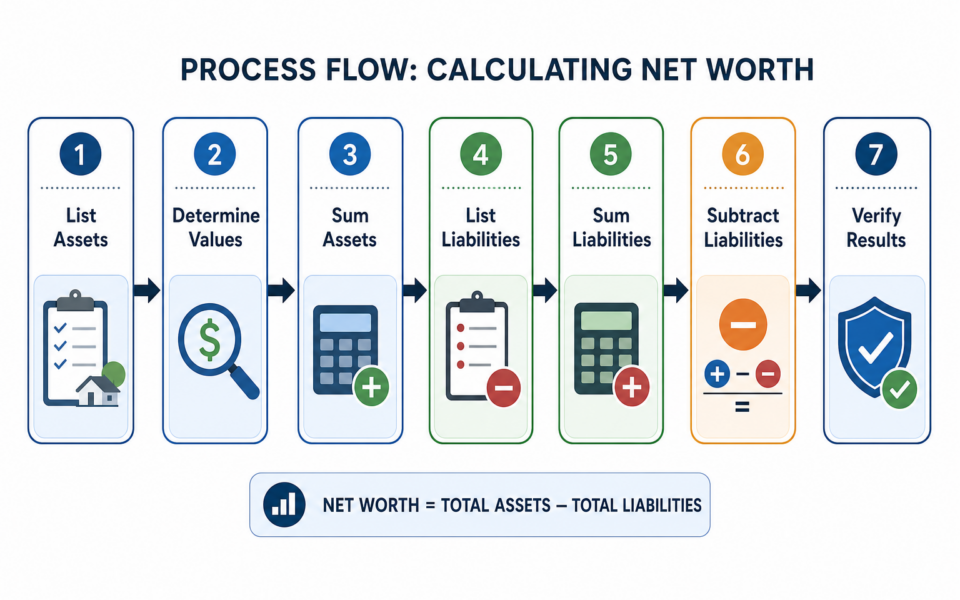
In practice, this means your net worth statement should show two line items:
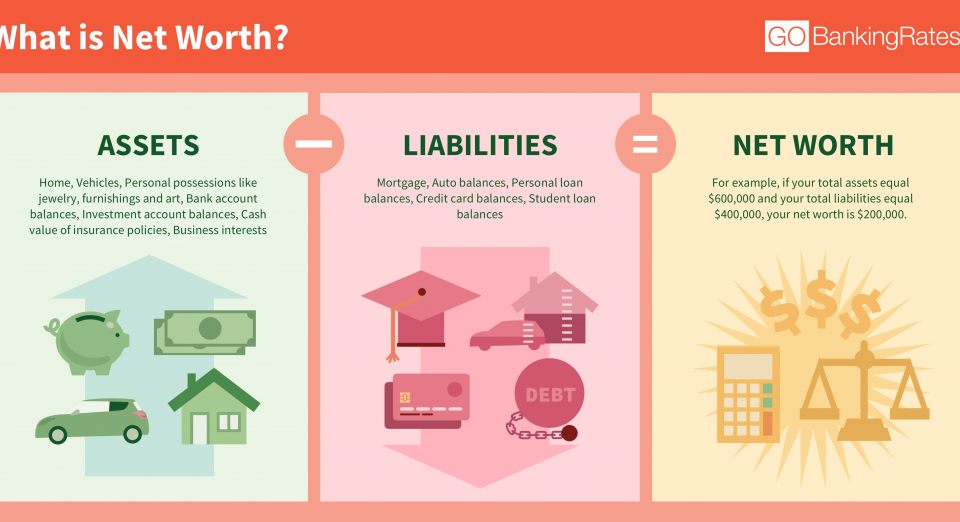
- Asset: 401(k) account at the full plan balance, including the loan receivable portion.
- Liability: 401(k) loan at its current outstanding balance.
Some people prefer to net the two and show a single figure. That’s mathematically equivalent and perfectly acceptable, as long as you’re consistent and understand what the number represents.
The two mistakes that distort your net worth
Errors in either direction are common, and each one throws off your net worth by the full loan amount [S1].
Mistake one: counting the reduced balance and the loan as a liability. If you look at your statement, see $55,000 invested, and then also list the $9,000 loan as a debt, you’ve effectively counted the loan twice — once as money missing from the account and once as money owed. This understates your net worth by $9,000 [S1]. The full plan balance already reflects the loan receivable, so subtracting the loan again from a reduced asset figure penalizes you twice.
Mistake two: counting the full balance and ignoring the loan. If you count the account at $64,000 and never list the loan as a liability, you overstate your net worth by $9,000 [S1]. The money you borrowed is sitting in your checking account, invested elsewhere, or already spent — but you still owe it back to the plan. Omitting the liability makes your balance sheet look better than reality.
A useful sanity check: think about where the borrowed cash actually went. If you borrowed $20,000 from a $100,000 account, the $20,000 now appears somewhere else in your net worth — your checking account, a home improvement, a paid-off credit card, or consumption that left no asset behind. Counting the full $100,000 balance alongside the cash you still hold would inflate your net worth, which is why the loan must appear as a liability [S2]. The alternative approach some people use — counting only the net $80,000 from the 401(k) — reaches the same destination by a different route, provided the borrowed cash is tracked separately [S2].
Should you use the statement balance, the vested balance, or an after-tax figure?
The balance printed on your 401(k) statement is rarely the amount that would actually land in your pocket if you withdrew it, and that gap matters for how meaningful your net worth figure is [S2]. Three adjustments deserve consideration.
| Basis | What it captures | Best used for |
|---|---|---|
| Full statement balance (including loan receivable) | Everything the plan holds for you | Standard net worth tracking; pairs naturally with the loan as a liability |
| Vested balance | Only the employer contributions you’ve earned the right to keep | A more conservative picture if you might leave your job soon |
| After-tax estimate | What you’d roughly keep after income taxes on withdrawal | Planning-focused or “liquidation” net worth views |
Vesting is the first filter. Employer matching contributions often vest on a schedule, so a portion of your balance may disappear if you separate from your employer before vesting completes. If your goal is a realistic picture of what you own, the vested balance is the more defensible asset figure [S2]. Note that vesting schedules vary by plan, and plan rules can change, so check your specific plan document rather than assuming a standard schedule.
Taxes are the second filter. Traditional 401(k) balances are pre-tax, meaning the government has a claim on a share of them. Some people build a separate “after-tax net worth” calculation that discounts retirement accounts by an estimated tax rate. There’s no single correct approach here; the important thing is to pick a method, label it clearly, and apply it consistently. If you use after-tax figures, apply the same logic to the loan: the loan balance is a nominal obligation, not a tax-adjusted one.
One caution on the loan specifically: if you leave your employer with an outstanding 401(k) loan, plan rules typically require repayment within a short window, and an unpaid balance may be treated as a distribution subject to taxes and possibly penalties. The exact rules depend on your plan and current law, which can change, so confirm the details with your plan administrator or a tax professional before relying on them.
Practical steps for your net worth statement
Putting this together takes only a few minutes once you know where to look:
- Pull your most recent 401(k) statement. Locate both the invested balance and the loan receivable (sometimes labeled “participant loan” or “outstanding loan”). Add them together for your asset figure.
- Find the current loan payoff amount. Your statement or plan portal should show the outstanding principal. Use the current figure, not the original loan amount.
- Record the asset and liability as separate lines — or net them deliberately, with a note explaining the method.
- Decide on vesting and tax treatment and document your choice so future calculations stay consistent.
- Update the loan balance each time you recalculate net worth. As you repay, the loan shrinks and the invested balance grows; the net figure stays roughly stable apart from investment performance and interest credited to your account.
One subtlety worth noting: the interest you pay on a 401(k) loan goes back into your own account, so repayment isn’t a pure expense in the way a bank loan payment is. For net worth purposes, though, you still record the loan as a liability and reduce it as you pay down principal. The interest component affects your cash flow and your account balance, not the accounting logic.
Frequently asked questions
Does a 401(k) loan reduce my net worth? Taking the loan itself doesn’t change your net worth, because the cash you receive offsets the new liability. What reduces net worth over time is spending the borrowed money on something that doesn’t hold value, or losing investment growth on the borrowed portion.
Can I just subtract the loan from my 401(k) balance? Yes, that’s a valid shortcut — count the account at its net invested balance and omit a separate liability line — but only if the borrowed cash is accounted for elsewhere in your statements [S2]. The shortcut fails if you also ignore where the cash went.
Should the loan be a short-term or long-term liability? Most 401(k) loans require repayment within a few years through payroll deductions, so classifying the balance as short-term debt is usually reasonable. Check your plan’s repayment terms, since they vary.
What if I have both a 401(k) loan and other debts? Apply the same principle to each: list every obligation at its current balance, and list every asset at a clearly defined value. Consistency matters more than any single classification choice.
The bottom line: a 401(k) loan is not a reduction in what your plan holds for you — it’s a shift in form, from investments to a receivable — paired with a personal obligation to repay. Count the full plan balance as an asset, count the loan as a liability, and your net worth will reflect reality rather than an accounting artifact.
Sources for Editorial Review
These are relevant pages found during drafting, not proof that any claim has been verified. Review factual statements and citations before publication.
- Editorial source lead [S1]: How to count a 401 (k) loan, a HELOC, or a car lease in net worth (zypper.com)
- Editorial source lead [S2]: Does 401k Count as Net Worth? Vested Balance, Taxes, Loans (fedlaws.org)