
Home Equity vs Home Value: Why the Distinction Matters
When people put together a personal balance sheet, the family home often becomes the single largest line item on the asset side. That is exactly where a common mistake creeps in: listing the home’s market value as if it were entirely yours. In reality, a property with a mortgage represents two very different numbers — what the home is worth and what you actually own of it. Understanding the difference between home equity and home value is essential for making smart financial decisions, especially when you are considering a HELOC, refinancing, or selling your home [S1]. These two terms get tossed around interchangeably, but they are not the same thing [S1].
This article explains how each concept works, how they interact on a personal balance sheet, and how to present them accurately so your net worth statement tells the truth about your financial position.
What Home Value Means
Home value is the market’s assessment of what your property would sell for in its current condition, in its current location, at a given point in time. It is a gross figure — the full price tag on the asset — and it belongs to the property, not to you personally. If your home is worth $500,000, that is the total value of the real estate, regardless of how much you owe on it.
Home value is inherently an estimate. It can be approximated through comparative market analysis, professional appraisals, or automated valuation models, and different methods can produce different numbers. It also moves with the housing market, local conditions, and the condition of the property itself. Because it changes and because it is always an estimate, home value on a balance sheet should be treated as a snapshot with a date attached, not a fixed fact.
What Home Equity Means
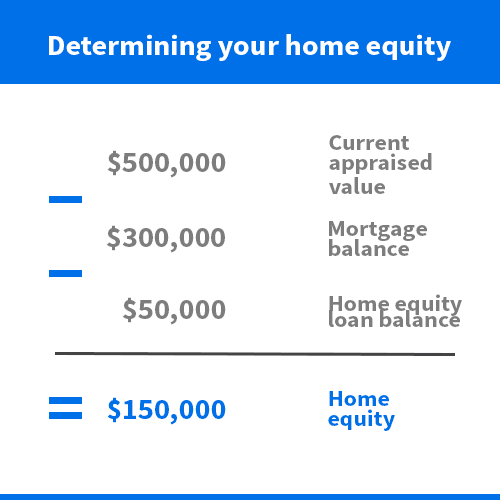
Home equity is the financial stake you personally hold in your property [S2]. It is calculated by subtracting your current outstanding mortgage balance from your home’s current market value [S2]. In plain terms, equity is “your” portion of the home’s value — the rest technically belongs to the lender until you pay off the loan [S1].
For example, if a home is worth $500,000 and the remaining mortgage balance is $300,000, the homeowner has $200,000 in equity [S1]. That $200,000 is the figure that represents genuine ownership stake, and it is the number that belongs on a personal balance sheet alongside other net-worth items.
Equity changes in two directions. It grows when the property’s value rises or when the mortgage balance falls through regular payments. If a home’s market value increases while the mortgage balance stays the same, equity grows by the exact amount of the appreciation — what some describe as passive equity growth, since wealth increases without the owner taking any action [S2]. For instance, if a $400,000 home appreciates to $450,000, the owner gains $50,000 in equity immediately [S2]. Conversely, equity shrinks if values fall or if the owner borrows against the home.
Why Home Value Should Not Appear as Your Asset
The most common balance sheet error is recording the full market value of a mortgaged home as a personal asset while either ignoring the mortgage or listing it separately without connecting the two figures. This can dramatically overstate net worth and create a misleading picture of financial health.
The cleaner approach is to recognize that the mortgage is a liability and that the home’s full value is not yours to claim. There are two accurate ways to present this:
- Net presentation: List only home equity as the asset. This is simple and directly reflects your ownership stake.
- Gross presentation: List the full home value as an asset and the outstanding mortgage as a liability. Net worth comes out the same, but the statement shows both sides of the transaction.
Either method is defensible as long as it is applied consistently. What is not accurate is counting the full value as an asset without recording the debt — that inflates net worth by the entire mortgage balance. Whichever format you choose, label the entries precisely: “Home value (estimated)” and “Mortgage balance” in the gross method, or “Home equity” in the net method. Clarity prevents double-counting and makes the statement useful for planning.
Side-by-Side Comparison
| Feature | Home Value | Home Equity |
|---|---|---|
| What it measures | Estimated market price of the property | Your ownership stake: value minus debt [S2] |
| Who it belongs to | The property itself; part is effectively the lender’s claim until the loan is repaid [S1] | You personally [S2] |
| How it changes | With market conditions, location, and property condition | Grows when value rises or balance falls [S2] |
| Balance sheet role | Asset (paired with mortgage liability in gross presentation) | Net asset; the figure that reflects true ownership |
| Typical use | Context for appraisals, offers, and market comparisons | Borrowing decisions, net worth tracking, sale proceeds |
How the Two Numbers Work Together in Practice
Home value and home equity are linked but not interchangeable. Value is the starting point; equity is the result after debt is accounted for. Because equity depends on both figures, it can behave in ways that surprise people. A rising market can lift equity even if the owner does nothing, while aggressive borrowing against the home — through a cash-out refinance or a home equity line of credit — can reduce equity even in a rising market.
This is why both numbers matter for financial decisions. Lenders evaluating a HELOC or refinance look at the relationship between the loan amount and the home’s value, which means they care about both figures. Sellers care about value because it drives the asking price, but they care about equity because it determines how much they actually walk away with after the mortgage is paid off. And anyone tracking net worth cares about equity because it is the portion of the home that genuinely contributes to personal wealth.
It is also worth being conservative when estimating value on a balance sheet. Since home value is an estimate that can shift with the market, using an overly optimistic figure inflates equity and, by extension, net worth. A reasonable practice is to use a recent appraisal or a well-supported comparative estimate, note the date, and update it periodically rather than treating any single figure as permanent.
Practical Steps for an Accurate Balance Sheet
- Obtain a defensible value estimate. Use a recent appraisal or a careful comparative market analysis, and record the date the estimate was made.
- Find your current mortgage balance. Use the payoff figure or the latest statement, not the original loan amount.
- Subtract debt from value to calculate equity [S2].
- Choose net or gross presentation and stay consistent. If you list full home value as an asset, always list the mortgage as a liability; if you list only equity, do not also list the mortgage separately.
- Label entries clearly so that anyone reading the statement — including you — understands which figure is which.
- Review periodically. Both value and balance change over time, so refresh the figures at least annually or after major events such as a refinance or a significant market shift.
The Bottom Line
Home value tells you what the property is worth; home equity tells you what you actually own. On a personal balance sheet, equity is the figure that reflects your true stake in the home, while value is context — useful, but not yours in full while a mortgage exists [S1][S2]. Recording the two correctly, and consistently, keeps your net worth statement honest and makes it a far more useful tool for decisions about borrowing, selling, and long-term planning.
Note that lending standards, valuation methods, and tax treatment of home equity can change over time and vary by jurisdiction, so confirm current rules with a qualified professional before acting on any borrowing or selling decision.
Sources for Editorial Review
These are relevant pages found during drafting, not proof that any claim has been verified. Review factual statements and citations before publication.
- Editorial source lead [S1]: Home Equity vs Home Value | HonestCasa (honestcasa.com)
- Editorial source lead [S2]: Home Equity vs Home Value: Key Differences Explained (homeequitycalc.online)





