
Why unpaid taxes belong on a net worth statement
A net worth statement is simple in concept: total assets minus total liabilities. What makes it useful—or misleading—is how faithfully the liabilities side reflects what you actually owe. Income tax that has been incurred but not yet paid is a real obligation, even if the bill has not arrived yet. Leaving it off makes your net worth look stronger than it is; including it gives you a more honest picture of where you stand.
This is not an abstract accounting exercise. If you have a side business, sold investments, received a large bonus, or simply underpaid during the year, you may be carrying a tax liability right now. If you are self-employed and make quarterly estimated payments, your balance sheet on any given date sits somewhere between tax accruing and tax paid. A net worth statement that ignores that gap is incomplete.
The general rule for a net worth statement is that assets are valued at today’s market price and liabilities are listed at the full amount owed as of the statement date [S1][S2]. Unpaid taxes fit naturally into that framework: they are a liability measured as of the date you prepare the statement.
Separate what you owe from what you’ve already paid
The most common mistake is double-counting or confusing timing. Taxes withheld from a paycheck, or estimated payments you have already sent, are no longer liabilities—they are money already out the door. What belongs on the statement is the remaining balance: the amount by which your total tax obligation for the period exceeds what you have already paid or had withheld.
A second distinction matters just as much: taxes that relate to a period you have already closed versus taxes accruing for the current, still-open period. If you filed a return and still owe on it, that is a fixed, known liability and should be listed at its full remaining balance. If you are mid-year and estimating what you will owe when you file, that is an accrued estimate—also a liability, but one you should label as estimated so the reader knows it is not a final number.
Finally, distinguish income tax from other tax obligations. Property taxes, payroll taxes if you run a business, and sales tax you have collected but not remitted are all liabilities in their own right. Grouping everything under one “taxes owed” line is acceptable for a personal statement, but separating the categories makes the statement easier to update and harder to misread.
A useful mental test: if you had to satisfy every obligation today, what would you still owe the tax authority? That number—not the total tax you expect to pay over the year, and not zero because you haven’t received a bill—is what goes on the statement.
A practical method for calculating the figure
You do not need professional software to get a reasonable estimate, but you do need to be systematic. The steps below work for most individuals and can be adapted for a small business.
- Pick a statement date. A net worth statement reflects a single point in time, so choose one date and use it consistently for every asset and liability [S1].
- Estimate total tax for the period. Use your most recent return as a baseline, then adjust for known changes: a raise, a new contract, realized investment gains, or a business that is growing. If you work with a preparer, ask for a projection as of your statement date.
- Subtract what has already been paid. Add up withholding shown on pay stubs and any estimated payments made through the statement date. The difference is your accrued unpaid tax.
- Add prior-year balances still outstanding. If you filed a return and did not pay the full amount, include the remaining balance, plus any interest or penalties that have accrued. Do not include amounts you have already paid, even if the payment cleared recently.
- Add other accrued taxes. Property tax billed but unpaid, sales tax collected but not remitted, and payroll tax deposits due but not made all belong here.
- Label the line clearly. Call it “unpaid income tax (estimated as of [date])” or similar, so anyone reading the statement understands it is an accrual, not a final assessment.
Keep your supporting calculation with the statement. If your estimate changes next month, you want to be able to see why—whether it was a change in income, a payment you made, or a correction to an earlier assumption.
Where it goes on the statement, and what to leave off
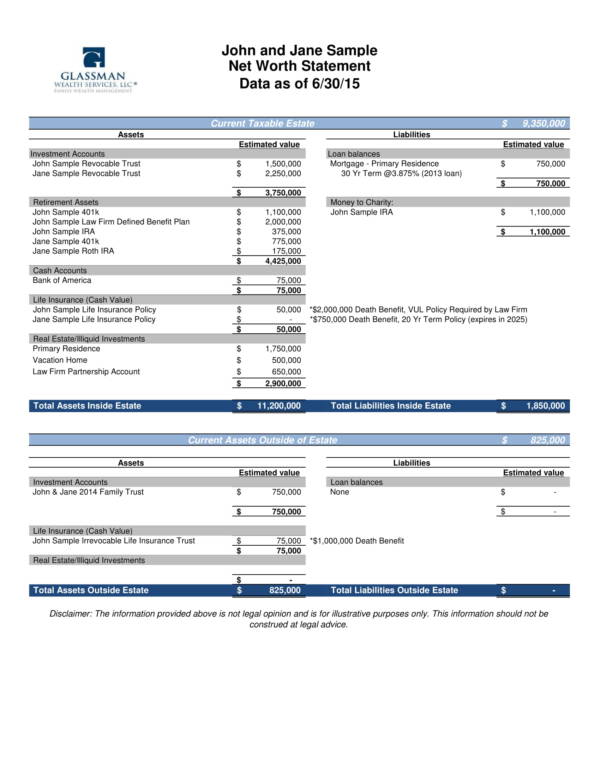
Unpaid taxes are a liability, not an asset, and they belong with the other debts: mortgages, auto and student loans, credit cards, and similar obligations [S1]. A simple layout makes the treatment clear:
| Line item | Treatment on the statement | Notes |
|---|---|---|
| Cash and bank accounts | Asset, current value | Use today’s balance [S1] |
| Investments and retirement accounts | Asset, current market value | Current values, not cost basis [S1] |
| Real estate and vehicles | Asset, current market value | Pair with the related mortgage or loan [S1] |
| Credit cards and installment debt | Liability, full balance due | List the entire balance as of the statement date [S2] |
| Prior-year tax still owed | Liability, remaining balance plus accrued interest and penalties | Do not include amounts already paid |
| Current-year accrued income tax | Liability, estimated | Total estimated tax minus withholding and estimated payments made to date |
| Other accrued taxes | Liability | Property, sales, and payroll tax due but unpaid |
| Future income tax on unrealized gains | Generally excluded | Leave out taxes on income you have not yet earned [S1] |
The last row is the subtle one. A net worth statement values assets at current market price and excludes future income, so it should not include hypothetical taxes on gains you have not realized [S1]. Your unpaid tax line should reflect obligations already incurred as of the statement date, not tax you might owe someday if you sell an asset. Apply the same principle to retirement accounts: the statement shows their current value as an asset, and the eventual tax on withdrawals is a future event, not a present liability.
One more exclusion: amounts you have disputed. If you are contesting a proposed assessment, the obligation may or may not stand. Many people still list the contested amount, with a note, so the statement errs on the conservative side—but describe it honestly rather than folding it into a final figure.
Keep the statement current and consistent
An unpaid tax figure ages quickly. A statement prepared in the spring, before a filing deadline, may show a liability that disappears once you pay; a statement prepared late in the year may show a liability that is still growing. Update the line whenever you make a payment, receive a final assessment, or materially change your income expectations.
Consistency across statements matters as much as accuracy on any single one. If you include accrued current-year tax this time, include it next time too, or your net worth will appear to jump for reasons that have nothing to do with your finances. Note your convention—whether current-year tax is included or excluded—near the top of the document.
Rules and rates change, and the treatment of specific items can depend on your jurisdiction and circumstances. The method above is a framework for an accurate personal statement; it is not tax advice. For anything involving a disputed assessment, a business with complex payroll obligations, or a statement prepared for a legal or lending purpose, confirm the approach with a qualified tax professional before relying on it.
Done properly, including unpaid taxes costs you a little extra work and gives you something more valuable in return: a net worth figure you can trust, one that reflects what you actually owe rather than what you happen to have been billed for so far.
Sources for Editorial Review
These are relevant pages found during drafting, not proof that any claim has been verified. Review factual statements and citations before publication.
- Editorial source lead [S1]: What Should Be Included in a Net Worth Statement? (financialaha.com)
- Editorial source lead [S2]: How Do I Fill Out My Net Worth Statement? – Part IV … (donaldwall.com)





