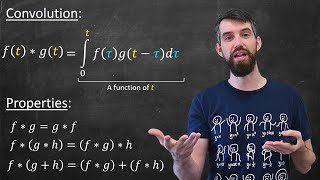
Web Reference: Theorem (Laplace Transform) If f , g have well-defined Laplace Transforms L[f ], L[g ], then L[f ∗ g ] = L[f ] L[g ]. Proof: The key step is to interchange two integrals. We start we the product of the Laplace transforms, hZ ∞ Sep 4, 2024 · We could use the Convolution Theorem for Laplace transforms or we could compute the inverse transform directly. We will look into these methods in the next two sections. Your solution’s ready to go! Our expert help has broken down your problem into an easy-to-learn solution you can count on.
YouTube Excerpt: Get complete concept after watching this video Topics covered under playlist of Laplace Transform: Definition, Transform of ...
Net Worth Profile Overview
20 Convolution Theorem Problem 2 Net Worth 2026: Salary, Income & Wealth Net Worth & Biography

Estimated Worth: $10M - $54M
Salary & Income Sources

Career Highlights & Achievements





![Differential Equation Convolution Theorem: y(t) - 2 [integral 0 to t] sin(2(t - v))y(v) dv = sin t Net Worth](https://i.ytimg.com/vi/LlE2KqB4qAk/mqdefault.jpg)
Assets, Properties & Investments
This section covers known assets, real estate holdings, luxury vehicles, and investment portfolios. Data is compiled from public records, financial disclosures, and verified media reports.
Last Updated: April 10, 2026
Net Worth Outlook & Future Earnings

Disclaimer: Disclaimer: Net Worth estimates are based on publicly available data, media reports, and financial analysis. Actual numbers may vary.